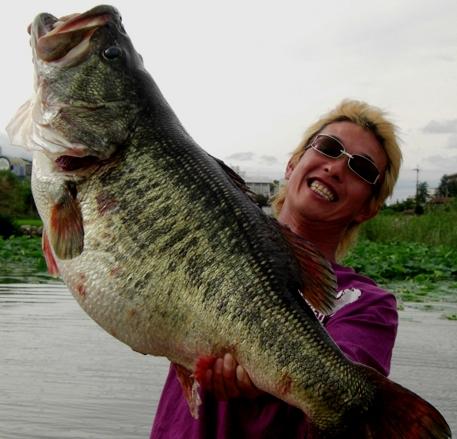
The bass world is abuzz again with reports of a new world-record largemouth bass. But this time the news is not from southern California, where Mac Weakley famously foul-hooked the 25-pound, 1-ounce Dixon Lake behemoth in 2006 and where, it’s been widely assumed, the record was bound to come from. Instead, as we reported late Thursday afternoon, it appears that the new No. 1, a reported 22-pound, 5-ounce giant, has been caught on the other side of the planet by Depps Tackle Co. pro-staffer Manabu Kurita, form Lake Biwa in the Shiga Prefecture of Japan.
If this fish’s reported weight holds up, Kurita’s 29.4-inch giant is 1 ounce heavier than George Perry’s 77-year-old, 22-pound, 4-ounce record. But Perry’s record will not fall; it’ll just have to make some room at No. 1—because International Game and Fish Association regulations require new world records of fish 25 pounds or less to weigh two ounces more than the previous one.
Keep an eye on this page for the latest news on this breaking story, which we'll post in the links below:
Comments (6)
That fish looks fake!
That's the biggest bass I've seen ... I only wish it was on the end of my St.Croix!
nice hair buddy
Thats a big bass
yep nice fish. if it a record good for him but i would love to the new #1 come from the USA.
Post a Comment
That's the biggest bass I've seen ... I only wish it was on the end of my St.Croix!
nice hair buddy
Thats a big bass
yep nice fish. if it a record good for him but i would love to the new #1 come from the USA.
UPDATE 8/27/09
Here is an email Matt Lures received from a very reliable source. He lives in Japan and owns a tackle store there. his name is Greg Vella
I have come to the conclusion that Japan will probably not allow the big bass to become a record (JGFA). There is just too much (political) at stake, with the recent push to make all of Japan “catch and kill” for bass and bluegill. The Japanese government has spent millions of dollars on this program, which includes supplementing the income of the commercial fisherman at Lake Biwa.
> Letting Mr. Kurita’s fish become the new Japan record (JGFA) will send the wrong type of message to the taxpayer, and draw unwanted attention to the positive aspects of bass fishing.
>
> Here is where we stand:
>
> I mentioned before a about the distance from the bridge restriction ( the bass was caught near the Biwako Bridge)–It seems that his boat was not within the restricted area, but now they are saying they are going to DQ him because he CAST into the restricted area (which is not legally a “restricted” area anyway). I don’t understand? Lake Mission Viejo has a 20 foot from the dock no fishing zone, but that means your boat must not be withing 20 feet when fishing, not your cast. Another example would be the buoy line at Perris, or Casitas. As long as your boat is outside the buoy line, you can cast wherever you want.
> This is weak.
>
> What is weaker is that they are now saying the he “broke the law” to catch the fish due to his bait (a bluegill). Bluegill are not illegal to be used for bait (nobody cares), but they are illegal to release back into the lake alive. The bass “No Release” law includes bluegill and everybody is aware of this due to posted signs all over the lake. But they are now saying that Mr. Kurita “released” a bluegill back into the lake when he pinned it on his hook, and tossed it in front of the giant bass.
>
> This is really pushing it, IMO.
>
> What they don’t know, and I just found out today, is that Mr. Kurita is registered, like I am, to be able to release bass and bluegill.
>
> Even so, I sure they will make up something else; they do not want this fish to become a record, because:
> As of two days ago, the paperwork has not even been submitted to the IGFA.
> JGFA is saying that it must pass their scrutiny before he is “allowed” to submit to the IGFA; it should not be this way, as the IGFA is a separate entity.
> It seems it is catch 22 for Mr. Kurita.
>
> There is so much misinformation going around that it is sad, at best. The same type of people that said the Biwa Lake grow fat on all the salmon (there are none) are giving opinions on stuff they know nothing about.
>
> Hope all is going well for you,
> Capt. G
And here is something else that crossed my mind today. If he used Live Bait, which was a Coi, it weighed at least 4 ounces, probably more, and you would think that the bass swallowed it after being caught, which means it had at least 4 ounces added to it artificially by the angler when it was weighed. Should this really count?
GENERAL GUIDELINES for WORLD RECORD APPLICATIONS:
FOR ALL CATCHES: Care should be taken to carefully preserve the fish, either alive or on ice. Proper documentation of the catch is crucial, so take plenty of pictures or even a video if possible. Save and preserve the line, leader, and tackle used.
Witnesses: At least one witness is highly desirable.
Time limits: All-tackle records have no time limit. Catches made in U.S. waters have 60 days from the date of catch, and 90 days for out of country.
Weighing: The fish must be weighed by an official weigh master, an IGFA official or a recognized local person familiar with the scale. If an IGFA representative or an IGFA officer is available, he or she should witness the claim. The scale must be checked and certified by a government agency or other qualified and accredited organization within the last 12 months, or submitted to IGFA with the application for testing.
Tackle: At the time of weighing, the actual tackle used must be exhibited to the weigh master and weight witness.
Line: For line class records: The entire leader, double line, and 50 feet of line is required for submission and must be intact and connected. Fly fishing records must be accompanied by the lure, entire tippet, entire leader and one inch of the fly line, and these components must also be intact.
Photographs:
Required: 1) The certified scale 2) The rod and reel 3) The full length of the fish 4) The angler with the fish.
Recommended: 1) The angler and fish at the time of the catch. 2) The fish displayed on the certified scale with the weight visible 3) The fish on a flat surface with a ruler beside the fish 4) A video of the catch.
Common disqualifications include but are not limited to: Using wire line, umbrella rigs, leaving the rod in the rod holder, resting the rod against the gunwale, entangling the line with another line, anyone touching the rod, reel, or line once the fish has taken the bait.
more articles and current info at Northeast trophy Bass http://delawaretrophybass.com
That fish looks fake!
Post a Comment