The Mid-Life Slam
Six miles from land in 8- to 10-foot swells is usually no place to have an argument over a 4-inch...

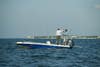
Six miles from land in 8- to 10-foot swells is usually no place to have an argument over a 4-inch fish. But here we are, seven experienced fishermen, heatedly discussing the identity of a little brown-barred creature as the charter boat heaves and yaws, knocking everyone off balance.
“Might be some kind of grunt,” says mate K.J. Zeher, grabbing a rod rack to keep steady.
“I don’t know.” Photographer Ron Modra takes four quick steps sideways as the boat rocks. “Looks like a young grouper.”
“You’re both wrong,” comes the voice from above, not God but one of several apparent close relations I will meet on this trip. This one is Alex Adler, captain of the 48-foot Kalex, looking down from the bridge. Adler has put me onto 15 different species of fish so far today and it’s not even lunchtime. “It’s a bass. Mike, check your books.”
He’s right. The fish is a saddle bass, found in 250- to 500-foot depths here off the Florida Keys. There’s a scar halfway down its flank–a souvenir from some larger fish beneath us, and there are plenty down there–but the mark didn’t throw off Adler, the expert fisherman and, I’m learning, amateur fish taxonomist.
Adler is 50, a milestone age I will reach this year. Like many men of my hairline, I have a family, a job, and a house, all of which demand most of my time and attention. So it might seem that I have better things to do than attempt to remain upright on a rocking boat about 90 miles from Cuba, some of the greatest gamefish in the world swimming in waters around me, preoccupied with a tiny fish wriggling in my hand.
But that is precisely why I am here.
Some men have a so-called midlife crisis when they turn 50. The number is a stark reminder that our lives are well more than half over. Many of us try to deny our fading and failing bodies by buying late-model European sports cars and using pills and ointments in a desperate attempt to retain the same virility, muscle tone, and short-term memory we had in our 20s.
I understood this well-documented reaction to aging on an intellectual level but didn’t really feel it until an AARP application arrived in my mailbox earlier this year. I stared at the envelope for a week but didn’t dare open it. Just what would be my reward for turning 50? A free large-print book? A discount on an early-bird special dinner at a chain restaurant? Or even (please, no!) The Clapper?
The thought was frightening. No wonder so many 50-year-olds run out to get botulism toxins injected into their face wrinkles and start using the salutation “Dude!” to begin every conversation.
What I wanted to do instead was what had always made me feel right about life–go fishing. A whole lot of fishing. And therein lay a perfect way to mark my 50th: Instead of staring aghast at 50 candles on a birthday cake, I’d spend a week trying to catch 50 different species of fish. It would be an exhilarating way to celebrate an inauspicious birthday, and cheaper than buying a car shaped like a giant Rapala Fat Rap.
To do this I needed a place that wasn’t too far from home, where I could spend a week without spending a fortune, where I’d have access to docks and boats and guides and a lot of water, so I could spend as much time as possible fishing. And, of course, where I’d have a realistic chance of catching 50 species.
The Florida Keys, a 125-mile island chain extending from the southeastern tip of Florida, seemed the ideal destination. The Keys have an incredible abundance of fish. There are billfish and dolphin a quick run offshore, bonefish and tarpon on the sandy flats, redfish and seatrout in the backcountry region, plus snapper and grouper and jacks and scores more species–various sources put the number at 400 or 500, total. No one knows exactly how many; maybe whoever started to count them got caught up in the great fishing and said to hell with the project.
It was a fail-safe plan, because if I didn’t catch the 50, I’d still be spending a week in fishing paradise. With no flaming cake to look at.
Days 1 and 2: It’s a Snap
In Carl Hiaasen’s novel Stormy Weather, Clinton Tyree, the itinerant and partially deranged ex-governor of Florida, has himself lashed to the railing at the apex of the Card Sound Bridge in order to witness a hurricane heading toward south Florida. As I drive over that bridge this late June day I don’t even see a cloud, just an expanse of brilliant blue water extending alongside and beyond Key Largo.
This bridge is one of two vehicle-accessible entries to the island chain. U.S. 1, the Overseas Highway, connects the Keys, which are formed of limestone outcroppings capped by ancient fossilized coral. Some are developed, some are not. Some are so narrow that you can stand in one spot and see both the Gulf of Mexico and the Atlantic Ocean, which the Keys–there are about 800 of them–essentially separate.
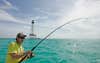
My destination is Upper Matecumbe Key and the village of Islamorada (EYE-la-more-AH-duh), about a third of the way down the island chain. Islamorada bills itself as “The Sportfishing Capital of the World,” and few argue the designation. Fishing boats bristling with rods occupy every dock–a wild array of party boats, offshore sportfishing boats, flats boats, cuddy cabins, walkarounds, and center consoles. Mounts of king mackerel and permit and marlin hang not just in tackle shops but in motels, restaurants, bars, and gas stations. Some are outside, so that you can see giant tarpon and great white sharks without leaving your car.
By the time I pull into Cheeca Lodge, my home for the next seven nights, it is near sunset. Cheeca is a large and beautiful resort on the Atlantic side. I am staying at this famous lodge, which I’ll only see early mornings and evenings, because my family will be joining me later in the week (my wife had eight words to say about my adventure–“You’re not going to the Keys without me”–and she and the kids will enjoy the swimming and the snorkeling here while I’m out on the water).
I’ve been traveling all day but I have fish to catch. So after checking in, I grab my rod and walk past the swimmers in the lagoon and the pool, past the outdoor restaurant. I ignore the calypso music emanating from the speakers in the palmettos and the quiet hum of a piña colada blender at the tiki bar. I resist all these temptations because of the other main reason I’m staying at Cheeca–a 525-foot-long fishing pier on the property.
I walk to the end and bait up with shrimp I bought at the Worldwide Sportsman across U.S. 1 from Cheeca. Looking down, I see a kaleidoscope of small fish, along with a 12-foot nurse shark cruising lazily around the pilings. I cast, and the shrimp flows with the tide for only a few seconds before I feel a sharp rap. I set the hook and shortly bring up an 8-inch light-colored fish with yellow lateral lines, a gray spot two-thirds back, and small, sharp teeth. I take a photo and drop it back into the water. Later that night my reference books will show that species No. 1 is a lane snapper, a common and good-tasting species.
With a dozen more fish, I add three more species–pinfish, margate, and bluestriped grunt–to my list. It’s well after dark now and I’m tempted to keep going, but 50-year-olds on a mission (who’ve been up since 4 A.M.) need their sleep.
The next morning I’m at Robbie’s Marina, a five-minute drive from Cheeca. Robbie’s is the home of the Captain Michael, a 65-foot party boat, as well as rental boats, snorkeling and diving services, and a huge school of giant tarpon that are being hand-fed baitfish by tourists at the end of a dock.
I watch the show until the boat leaves. Our destination, according to Capt. Ron Howell, is a reef 31⁄2 miles from shore on the ocean side, where we’ll go after yellowtail snapper.
The boat can hold 53 people, and we are about half full. We cross under U.S. 1 at the Indian Key Channel Bridge. I marvel at the various hues of the water–azure, turquoise, emerald–that change with depth and bottom composition.
We reach the reef 3 miles out. Howell circles it while mate Marshall Hill puts out chum bags. We anchor and drift our baits into the slick. I’m fishing a squid strip on a 1⁄16-ounce yellow jig. A school of sublegal dolphin–“chickens”–shows up, and one grabs my bait. There are bigger dolphin farther offshore, but on this trip, size doesn’t matter. It’s species No. 5.
The yellowtail show up in the chum slick, their golden tails flashing, but they’re not biting well. “The water’s too clear,” says Howell. “They’re spooky.” Hill has me change to a No. 4 bait hook with a small strip of ballyhoo, a baitfish common to these waters, and I’m quickly on with what will turn out to be my only yellowtail.
From the bridge, Howell eyes my fluorocarbon leader disapprovingly. “Twelve-pound pink Ande mono will outfish fluoro here,” he says. “See that guy?” A customer who has spooled up with the stuff is fast into his seventh fish. But I already have my yellowtail, so I can’t focus on this terrific fishing for one of the most delicately flavored fish in the ocean, anyway. But I’m okay with that. I think.
Hill has me change rigs again, and I luck into a blue runner (No. 7). Yet another change gets me a smashing hit from a barracuda, but I can’t stick the hooks. Still, I’m up to seven species.
Back on shore I grab lunch and return to Robbie’s, where I paddle one of their kayaks out to a mangrove creek on the Gulf side of the key. I’ve been instructed to go past the second bend, tie off to a branch, drop a chum bag, and toss a lightly weighted live shrimp into the slick.
The creek is narrow and shady with a deceptively quick current, but I’m comfortable in this setup because I fish Barnegat Bay from a kayak back home in New Jersey. That’s also why the feel of a fly landing on my inner thigh as I sit spread-eagled in the ‘yak doesn’t seem out of place. I am concentrating on the fishing and try to shake the fly off without taking my eyes from my line. When it doesn’t move and I look down to see not a fly but a silver dollar-size crab disappearing up my shorts leg, I nearly capsize.
I quickly remove the crab, the creek eventually settles back down, and the orange-finned schoolmasters and gray (mangrove) snappers smack the shrimp. That brings my species count up to nine; my phantom-itch count in bed that night reaches about 3,000.
**
Days 3 and 4: Too Many Snook**
When I was 15 years old, I was fascinated by the book A Journey to Matecumbe by Robert Lewis Taylor. In it the young Davey Burnie travels by dugout canoe through the Everglades on his way to the Florida Keys, sleeping on island hummocks and eating stew made from alligators that were captured by Seminoles.
What backcountry guide Jim Willcox and I are looking at, however, is nothing so mundane as a gator. It is an American crocodile, a 12-footer resting in the dappled shade of the mangroves out here where the Everglades meet Florida Bay. This is one of about a thousand crocodiles that inhabit the southern tip of Florida, and Willcox has beached the bow of his 18-foot Action Craft flats boat on the island so we can get a better look at it.
American crocs are a threatened species, downgraded from the endangered list last year. Right now, though, I’m the species that feels unsafe. The croc is 30 feet away.
“That’s a big one,” says Willcox. “But even big ones are fast.” I shift my weight from starboard to port to make sure that the hull isn’t stuck fast in the marl.
We’ve motored about an hour from Bud N’ Mary’s Marina in Islamorada through Florida Bay to get to this maze of islands, shoals, broad expanses of water, and snakelike creeks. Willcox, 52, seems to know every inch of it.
The day before, Willcox and I had fished a number of patch reefs–isolated coral outcroppings within a mile or two of shore–and added eight species to the list. Willcox wanted to fish the backcountry today so I could reach my halfway point.
And we’ve done well. So far today I’ve caught sea catfish (No. 18), jack crevalle (No. 19), spotted seatrout (No. 21), snook (No. 22) and, in a model of fishing efficiency, a 100-pound bull shark (No. 23) that ate a ladyfish (No. 20). I also jumped and lost a tarpon, but my self-imposed IGFA tournament rules dictate that a fish isn’t considered caught unless I bring it close enough for me to touch the leader.
What I need to catch is a redfish. But here, in the slow current of the creek bend, I am hooking snook after snook.
“Let’s get the hell out of here,” says Willcox. “The snook are biting like crazy.” He looks at me. “I’ve never said that before in my life.”
We motor through open water to a heavily shoaled shoreline. We have to anchor the boat and walk through shallows to get to the mouth of a tiny mangrove- and cypress-lined flowage that Willcox says is home to my redfish.
The outgoing tide is very warm, exposing shoals that are ankle-deep with seashells that would cost a dollar each at a Miami airport souvenir shop. Along the shoreline I see cuts and holes, channels and dropoffs, eddies and deadfalls. We haven’t seen another fisherman in hours. I want to stay right here for the next four to six weeks and fish it all. But Willcox points to the creek. “Cast a shrimp upcurrent,” he says. I slowly wade toward the mouth, working the waist-deep water as I go. On my fourth cast my line wraps around an overhanging mangrove branch, and I have to cross to the steep opposite bank to free it.
I swing the rod to loop the line off the branch, and that, of course, is when the redfish sucks in the shrimp.

The creek is about 10 feet wide, the red is about 6 pounds, and I can see about 300 places for him to wrap me. But I’m not going to lose this fish, which now wants to swim back through the Everglades and all the way to Lake Okeechobee. I hear Willcox rapidly sloshing through the water toward me. “Just beach it!” he’s yelling.
I’d once lost a 5-pound smallmouth trying to do just that on a Pennsylvania lake when my landing net was lying forgotten somewhere, but I have no other option. I crank down on the fish and in one motion sweep the rod back, take two steps up, and drag the red onto the bank. Then I fall like a sack of cement so my body is between water and fish, and pin it with my forearm. Willcox gets there a few seconds later. “Smooth,” he says. “You’re not ready for AARP yet!”
By the time we get back to the dock, I’ve reached 27 species. More than halfway, and time to get out on the big water.
Days 5 and 6: Preparing for a Sword Fight
In The Old Man and the Sea, Ernest Hemingway’s Santiago battles an 18-foot blue marlin from a skiff in the Florida Straits, where the Gulf Stream begins between Cuba and the Florida Keys. I am in those very waters now and much better equipped than Santiago, who had only a hook and a handline. I’m sitting in a fighting chair on the deck of the 56-foot Catch-22, piloted by Capt. Scott Stanczyk. I watch as mates Nick Stanczyk, Scott’s nephew, and K.J. Zeher carefully put a rod with a Penn International 80 reel loaded with 100-pound-test line in the gimbal between my legs.
The reel’s giant spool looks sparse at the moment, though, because at the other end of the quarter mile of line leading from the rod tip and practically straight down from the transom is, we hope, a big broadbill swordfish.
To get here we passed through the waters I was in yesterday with Adler on his Kalex, where I caught that little saddle bass (No. 43) we all argued about, and 19 other species. Some were truly incredible–from the impossibly tiny-mouthed filefish (No. 32), to the blue parrotfish (No. 35) that looked like wet sapphire, to the 2-foot-long remora (No. 34) that Adler insisted could adhere to my belly and hang there (it did, and the sensation was like having a vacuum-cleaner hose with a thousand tiny needles at its end stuck to your skin).
I ended the day by catching a behemoth 25-pound permit–my 47th species, and a trophy fish on any trip–and we whooped and hollered our way back to the marina.
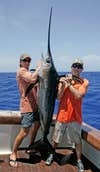
Here on the Catch-22, though, everyone is quiet as the boat rises and falls in the swells, as if the big billfish more than 1,500 feet below could sense us. I knew that Richard Stanczyk–the owner of Bud N’ Mary’s, who is on board today, directing operations–had perfected a method of fishing for swordfish in daylight, involving 10 pounds of concrete weight, several large lightsticks, a large baitfish (today’s was a butterflied 5-pound cero), and a hell of a lot of line. What I didn’t know was that we would troll up a blackfin tuna and an almaco jack on the 40-mile ride out here, meaning I’d have a shot at a sword for my 50th species.
Nick is perched on the transom, the line from my rod in his gloved hand. “He’s on,” he says to me, almost casually.
“Huh?” I say stupidly.
“He’s on! Start cranking!”
It takes me a few minutes to feel the fish but there’s no doubt when I do. Zeher–who mates on a number of boats out of Bud N’ Mary’s–slips a fighting harness around me and clips the reel to it, so I can lean back to gain slack, then reel it in as I drop forward. Do this a couple of hundred times with a fish almost as big as you on the other end of the line, and you start wondering how much ibuprofen is on board.
I’m alternating between cranking, cursing, and praying as the fish turns and peels off a football field’s length of my preciously gained line, then seems to have shaken the hook when the line goes slack. But he’s still there. He’s swimming toward the surface, and in a few minutes I see the electric gray of his flank. Nick and Zeher are ready with gaffs, and the 125-pound sword is eventually in the boat, thumping and thrashing. There is a lot of emotional yelling from everyone on board.
I’ve done it. But I realize something else.
Among all the backslaps and grins and handshakes, I know that these men and all the other guides on this trip are happy not just for my accomplishment but for their contribution to it. Like me, fishing makes them feel good about life. Besides, my 50-species one-week midlife slam became a personal challenge for them; a test of their fishing knowledge and prowess. Helping me attain that goal was a way of proving their ability.
“You did it!” says Nick.
“We sure did,” I say.
Day 7: A Bone to Pick
My last day here is with Capt. Vic Gaspeny, a bonefish and tarpon fishing legend on these waters. My 16-year-old son, Joe, is with me, and he wants to catch his first bone. I’ve never caught one either, but after the largesse of the week and hitting my goal of 50, I’m content to watch.
Gaspeny anchors on a flat within shouting distance of U.S. 1 and casts out lightly weighted shrimp from four rods. One of them twitches less than 10 minutes later, and Joe is soon running miniature laps around the boat, trying to keep a straight line angle to the bone. Gaspeny eventually nets the 4-pounder.
Joe repeats the exercise a few minutes later, and again soon after that. He’s caught 11 pounds of bonefish in about an hour, and when a rod twitches for the fourth time, I grab it. Joe and Gaspeny laugh. “Change your mind, Dad?” asks Joe.
“One for good luck,” I say. The bone tears off, the spool spins, and I think, I never caught a tarpon. Could I catch 60 tarpon in a week?