_We may earn revenue from the products available on this page and participate in affiliate programs. Learn more ›
_
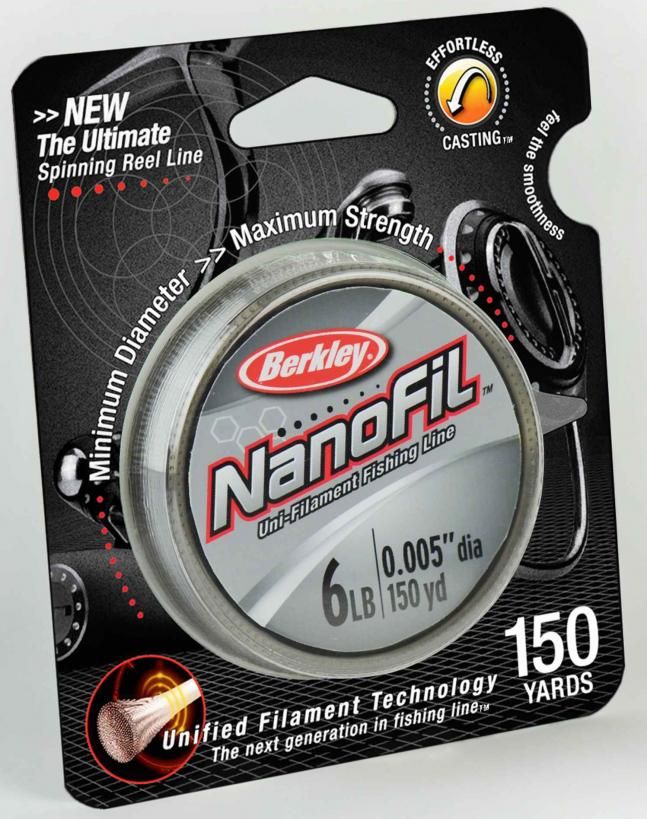
There’s a new fishing line out from Berkley this month that you’re going to be hearing a lot about. It’s called NanoFil. The company says it’s the strongest, thinnest line ever, designed specifically for greater casting distance and enhanced sensitivity with light- to medium-weight spinning tackle. I’ve finally obtained a sample, so here’s a quick report.
The line is made from Dyneema (gel-spun polyethylene) fibers as are many of the company’s other superlines. In this case, though, the fibers aren’t braided but are “molecularly linked and shaped into a unified filament,” according to Berkley. So while the line is effectively a single filament, it’s not a monofilament in the sense of extruded nylon lines. (Nor is it the same as Berkley’s FireLine, in which Dyneema fibers are fused by heat.)
It is round in cross-section, but not hard round like nylon monos. I can, for example, somewhat flatten a section of NanoFil with my thumbnail. It is, indeed, extraordinarily strong for its diameter. My sample spool is labeled 8-pound-test and .006″³ diameter. I measured the diameter at .007″³, so it’s pretty close to spec.
On my line tester, meanwhile, samples of 8-pound (labeled) NanoFil broke as high as 16 pounds. That’s really quite amazing considering how thin the stuff is in the first place. The line is fairly limp, having little to no memory.
Walleye, bass, and trout anglers all stand to benefit. Casting distance will be increased (to the extent that that’s an issue, which it isn’t always). I will, for example, be able to throw a small spinner much farther out into my local trout pond when fishing from shore. And I will be able to finesse smaller baits more easily for both bass and walleyes.
Like most polyethylene-based lines, NanoFil is extremely slick and slippery, requiring special knots. Berkley recommends a “NanoFil Knot,” which is your basic Palomar with an extra turn. You can find excellent animated knot schematics here
.
NanoFil is expensive. Are you surprised? A 150-yard spool starts at $19.95. The line will be available in 1-, 2-, 3-, 4-, 5-, 6-, 8-, 10-, and 12-pound tests. The 1-pound specs at an incredible .001″³ while the 12-pound specs at .008″³. The color is a milky white translucent, meaning not clear but not completely opaque either. I’m told it will start appearing on tackle-store shelves by mid-June.
So do I like this stuff? Yes! The only drawback I can see, other than price, is that people will have a difficult time tying some knots because of the line’s extremely small diameter. Fine diameters are just that much harder to work with for fumble-fingered folks. So take a deep breath and take your time.
THE 1871 CLUB