


May 03, 2013
On the Level: A Simple Method For Aligning Vertical Crosshairs
By David E. Petzal

I’d guess that of all the scoped rifles I’ve handled, probably ninety percent have the crosshairs out of vertical alignment. The reason is that when you look through the scope you have your head canted, and when the vertical crosshair looks straight to your crooked head, it ain’t. Crooked scopes cause you to cant the rifle, which causes the bullet to fly to the right or the left of the axis of the bore, which means you’re going to miss right or left when you shoot at 250 yards or more.
Over the years I’ve seen various gadgets that purport to enable you to mount the damned scope straight. A couple of days ago, however, I learned about a way to do the job that is sublime in its simplicity and requires only a carpenter’s spirit level. Here’s how it works:
1. Go to the rifle range. Set your unloaded, open-bolted rifle on the sandbags and brace it solidly. Find a flat spot on the receiver and lay the spirit level across it to see if the rifle is vertical. If it isn’t adjust accordingly.
2. Hike down to 25 yards and set up a target. Using the spirit level, draw a vertical line in an attractive spot on the paper and then apply a piece of black tape that aligns with the vertical line.
3. Go back to your rifle and, with excruciating care, set your scope in the rings and align it so your vertical crosshair is parallel with the tape on the target. Now it’s time to tighten your ring screws.
4. If you have rings that torque the scope tube clockwise or counterclockwise (a lot of them do) you’re probably due for a half-hour of serious aggravation. The best way to handle the job is by tightening things very gradually and checking alignment as you go. Avoid the temptation to emit little shrieks of rage or throw things.
5. If, when you finish and mount the rifle to check the sight picture the crosshair doesn’t appear vertical, don’t worry, it is. You are crooked, not your scope.
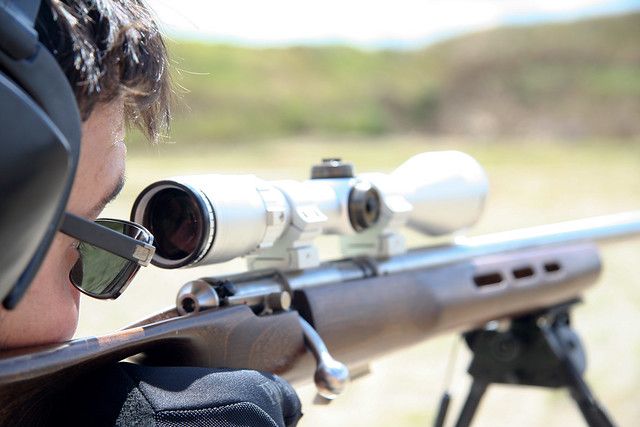
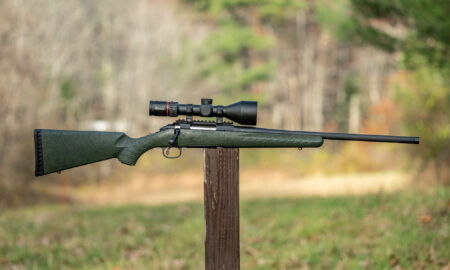
Photo by AMagill on Flickr

Comments (25)
I have sometimes had trouble finding that flat spot on the receiver. In that case I have used the bottom ring (if they are horizontally split)to be the flat spot. It seems to work fine. Am I crazy or is this correct?
Huntslow: That sounds like the reasonable way to do it, like on the round rimfire rifle receiver in the photo. I'm going to check out a device called "Reticle-Tru" mentioned recently in a gun magazine.
Sometimes do to unforeseen circumstances either no range available or weather at a brisk minus 82 below makes it difficult to get out.
I just remove the bolt, set the scoped rifle on a solid somewhat level rest, move just far enough back behind the rifle to see both the center axis of the bore and the vertical crosshair and rotate the scope. If your unable to remove the bolt, I move back further and use the butt plate screws as reference. Works good enough for those 500-700 yard shots.
I like Clays method. Either that or use a level on the receiver (if possible) then put that same level on top of the scope cap. Once both are level you're all set, no need to even look down the scope and use the crosshairs.
I bought a scope leveling kit made by Wheeler a few years back. Very good money spent.
I use the level level kit by wheeler. Works for me.
My crosshairs are aligned in my home office, which is just shy of 30 feet long. After leveling the rifle (using a spirit level), I line up the verticle crosshair against a neon-pink plumb-bob line that is held by Jack Ten-High's antlers. Jack is a whitetail who moved to Arizona from Texas after being harvested at just under 400 yards. The black crosshair is easy to align using the contrast of the neon-pink line.
I've aligned crosshairs for friends who thought theirs' was already vertically aligned. That is, until they saw clearly it wasn't when compared to the pink line. The line reveals that it can easily be off by 10 degrees but look OK when the rifle is shouldered.
Thinking about it further, why don't scope and rings manufactures like Leupold make a combination that would always be square. I would think that would be pretty simple to do.
Uh I need to ask a question Dave. How does that bullet go left or right when gravity generally works straight down? Wouldn't the bullet fall straight down from the axis of barrel even if you held the rifle upside down? When I shot DCM competition one of the service manuals we had showed a man in the sitting position canting the rifle 10 to 15 degrees and there comment was as long as the cant was consistent every time that it would not matter and these guys were shooting 600 yards.[ Another thing I notice as I suffer from DEP disease [left-hand] is when we pick up a right hand shooters rifle and look through the scope as a left hander it's REALY canted the wrong way. When right handers look through my scope same reaction.] If the bullet did go to the left or right with a shooter canting it wouldn't that mean that the rifle barrel would have to be keyed precisely dead nuts on in the receiver and if it was off just a few degrees it wouldn't matter if the scope was mounted correctly or not the bullet would go to the left or right? Set me right or wrong DEP. Thanks
If you can't find a flat spot try taking the barreled action (Bolt guns only for the most part) out of the stock, and hope there is a flat bottom on the receiver!
Alot are flat bottomed, I mount alot of scopes this way.
Well, if the scope is off center of the rifle bore you have a bullet leaving to the left or right of the line of sight, then crossing line of sight at point of zero and then continuing on the opposite side of line of sight getting ever further from line of sight until it strikes something.
And if the vertical is off and you holdover at long distance so is your shot.
CrowMan2, With the CMP you are firing at known ranges and you will likely adjust both elevation AND windage for each range. At least I did with both M1 Garand and M14. (You would have to have a very consistent cant.) With a scoped rifle for the field, most people set the crosshairs and don't move them. Now with "tactical" craze, some do change the vertical setting but resist changing the windage.
DEP's method is pretty much the one I worked out by trial and error a few years ago. Only difference is that I have a couple of fence pickets at the end of the yard that happened to have a perfectly level vertical gap between them. Also lucky in that they're almost exactly 25 yards away from my kitchen table. I had been putting rifles in a cardboard box with some cutouts for the barrel and pistol grip, but I finally broke down and bought a decent gun vise a few months ago. Other than a small carpenter's level and some gunsmith screwdrivers that's all the equipment I use, and I haven't had any problems leveling scopes or bore-sighting.
the key, and usually the toughest part of this is to get the rifle level, and in some cases, repeatedly level. i have used a small pocket line level for this purpose for years. and it works beyond a shadow of a doubt. as long as you can find a spot on the rifle that is flat. other places to check is the magazine opening at the bottom of the rifle. something solid and flat held against that, can give you a surface to level the rifle from. of course, you could always remove the scope mount caps, and the scope and level across the mounts. as a last resort, a properly fitting pin punch thru the swivel studs may also work, if they were installed properly (square). once the rifle is level, and stays that way, the rest is pretty easy.
My bore sighter has a level that will sit on weaver type mounts before mounting scope. after leveling gun thighten it in my gun vise, then the level fits the bore sighter for an accurately leveled crosshairs....
My problem isn't "leveling a scope. I've always used a torpedo level.
My problem is those (ricken! fracken' snackle!) Weaver style rings!
Mike G. set the scope off kilter with his bore sighter grid. When he cinched down the screws, it torqued the scope into perfect alignment! NOT ME! I'd tilt the scope the prescribed amount, torque the screws and the scope would either over rotate or not move at all! They don't, don't, don't, don't, don't ...... Sorry! They DON'T bother me anymore 'cause I always use split rings now. (whew!)
Far as I'm concerned, Weaver was one sick puppy! Didn't say the rings weren't any good, but who in their right mind would design a scope ring that "twisted" as it tightened?
I also have a drawer full of gizmos I have collected over the years to square up a reticle. The most recent, and effective, is Wheelers' Level, Level, Level. This device is simple to use and reliable as well as being handy for indoor applications. When I was a kid I watched an old timer align the cross hairs of his Weaver simply by using the line created by the surface of very dark tea in a half filled pint jar. It worked for him.
Logical, simple and it works, good tip Clay. +1
Crownman2,
I don't think it is the bullet that does anything different. Where the rifle is aimed is off. If the reticle is canted in relation to the barrel, the point of impact at longer ranges will not be where the reticle was pointing.
tygh98, it is indeed the bullet doing something different. It's gravity working on the bullet and at long range with a gun tilted the bullet will strike at a different point than the crosshairs are alighned with the target. It's the same as a crosswind but different direction.
This is why a level mounted on the rifle is a great help at long range shooting,
I'm sorry, tygh98 and you othere guys, I was thinking the rifle itself as being tilted.. you are correct.unless you are using a mil-dot or other than just crosshairs. and not using the verticle as a compensater.
I too have struggled with this issue for years!
I found Wheeler Engineering’s “Level-Level-Level” is an inexpensive tool (less than $20) for correcting this issue at home without burning precious range time.
I found that in my modest collection of scoped rifles (5) NONE of the cross hairs were set properly. Of course, after you have made the corrections to your scope mounting you have the excuse “Honey, I have to go to the range today. These things are all messed up and the only way to be sure they are fixed, is to shoot them!”
Hey, it worked for me!
to Crow Man 2,
This works in the same way as in archery.
Most modern archery sighting systems have levels built into the sight housing allowing the shooter to have repeatable reference to the perpendicular. Yes gravity does pull straight down but let’s assume for a moment the weapon is sighted in with a 5 degree cant and then is actually shot with a 10 degree cant the round will wander toward the angle of the cant. The greater the range from the platform, the grater the error will be.
Canting will always be aggravated when shooting horizontally around a sloped hill.
In all probability, your training manual was discussing the shooting of enemy targets and it is well known that humans do not require precise hits to remove them from a conflict. The vital area of a human target can be a circle as much as 12 inches in diameter. At 600 yards a canted rifle of 5 or 6 degrees still places the projectile within the critical area of the target. It is interesting that the 5.56 round effective accurate range also falls in around that 600 yard mark. With open sights a 600 yard one shot hit is a pretty good feat for an infantryman.
Military riflemen are rarely as interested in maximum accuracy as much as firearms enthusiasts. Their shooting is not a pastime but a requirement for survival.
Snipers, on the other hand, view extreme accuracy in a different light.
Today we see more and more scope mounting rings with a built-in level as a reference to perpendicular to extract the maximum accuracy potential from the shooting platform.
Interestingly, you will see the same sort of ring mounts more and more frequently on snipers’ weapons.
Post a Comment
Sometimes do to unforeseen circumstances either no range available or weather at a brisk minus 82 below makes it difficult to get out.
I just remove the bolt, set the scoped rifle on a solid somewhat level rest, move just far enough back behind the rifle to see both the center axis of the bore and the vertical crosshair and rotate the scope. If your unable to remove the bolt, I move back further and use the butt plate screws as reference. Works good enough for those 500-700 yard shots.
My crosshairs are aligned in my home office, which is just shy of 30 feet long. After leveling the rifle (using a spirit level), I line up the verticle crosshair against a neon-pink plumb-bob line that is held by Jack Ten-High's antlers. Jack is a whitetail who moved to Arizona from Texas after being harvested at just under 400 yards. The black crosshair is easy to align using the contrast of the neon-pink line.
I've aligned crosshairs for friends who thought theirs' was already vertically aligned. That is, until they saw clearly it wasn't when compared to the pink line. The line reveals that it can easily be off by 10 degrees but look OK when the rifle is shouldered.
I have sometimes had trouble finding that flat spot on the receiver. In that case I have used the bottom ring (if they are horizontally split)to be the flat spot. It seems to work fine. Am I crazy or is this correct?
Huntslow: That sounds like the reasonable way to do it, like on the round rimfire rifle receiver in the photo. I'm going to check out a device called "Reticle-Tru" mentioned recently in a gun magazine.
I bought a scope leveling kit made by Wheeler a few years back. Very good money spent.
DEP's method is pretty much the one I worked out by trial and error a few years ago. Only difference is that I have a couple of fence pickets at the end of the yard that happened to have a perfectly level vertical gap between them. Also lucky in that they're almost exactly 25 yards away from my kitchen table. I had been putting rifles in a cardboard box with some cutouts for the barrel and pistol grip, but I finally broke down and bought a decent gun vise a few months ago. Other than a small carpenter's level and some gunsmith screwdrivers that's all the equipment I use, and I haven't had any problems leveling scopes or bore-sighting.
I also have a drawer full of gizmos I have collected over the years to square up a reticle. The most recent, and effective, is Wheelers' Level, Level, Level. This device is simple to use and reliable as well as being handy for indoor applications. When I was a kid I watched an old timer align the cross hairs of his Weaver simply by using the line created by the surface of very dark tea in a half filled pint jar. It worked for him.
I like Clays method. Either that or use a level on the receiver (if possible) then put that same level on top of the scope cap. Once both are level you're all set, no need to even look down the scope and use the crosshairs.
I use the level level kit by wheeler. Works for me.
Thinking about it further, why don't scope and rings manufactures like Leupold make a combination that would always be square. I would think that would be pretty simple to do.
Uh I need to ask a question Dave. How does that bullet go left or right when gravity generally works straight down? Wouldn't the bullet fall straight down from the axis of barrel even if you held the rifle upside down? When I shot DCM competition one of the service manuals we had showed a man in the sitting position canting the rifle 10 to 15 degrees and there comment was as long as the cant was consistent every time that it would not matter and these guys were shooting 600 yards.[ Another thing I notice as I suffer from DEP disease [left-hand] is when we pick up a right hand shooters rifle and look through the scope as a left hander it's REALY canted the wrong way. When right handers look through my scope same reaction.] If the bullet did go to the left or right with a shooter canting it wouldn't that mean that the rifle barrel would have to be keyed precisely dead nuts on in the receiver and if it was off just a few degrees it wouldn't matter if the scope was mounted correctly or not the bullet would go to the left or right? Set me right or wrong DEP. Thanks
If you can't find a flat spot try taking the barreled action (Bolt guns only for the most part) out of the stock, and hope there is a flat bottom on the receiver!
Alot are flat bottomed, I mount alot of scopes this way.
Well, if the scope is off center of the rifle bore you have a bullet leaving to the left or right of the line of sight, then crossing line of sight at point of zero and then continuing on the opposite side of line of sight getting ever further from line of sight until it strikes something.
And if the vertical is off and you holdover at long distance so is your shot.
CrowMan2, With the CMP you are firing at known ranges and you will likely adjust both elevation AND windage for each range. At least I did with both M1 Garand and M14. (You would have to have a very consistent cant.) With a scoped rifle for the field, most people set the crosshairs and don't move them. Now with "tactical" craze, some do change the vertical setting but resist changing the windage.
the key, and usually the toughest part of this is to get the rifle level, and in some cases, repeatedly level. i have used a small pocket line level for this purpose for years. and it works beyond a shadow of a doubt. as long as you can find a spot on the rifle that is flat. other places to check is the magazine opening at the bottom of the rifle. something solid and flat held against that, can give you a surface to level the rifle from. of course, you could always remove the scope mount caps, and the scope and level across the mounts. as a last resort, a properly fitting pin punch thru the swivel studs may also work, if they were installed properly (square). once the rifle is level, and stays that way, the rest is pretty easy.
My bore sighter has a level that will sit on weaver type mounts before mounting scope. after leveling gun thighten it in my gun vise, then the level fits the bore sighter for an accurately leveled crosshairs....
My problem isn't "leveling a scope. I've always used a torpedo level.
My problem is those (ricken! fracken' snackle!) Weaver style rings!
Mike G. set the scope off kilter with his bore sighter grid. When he cinched down the screws, it torqued the scope into perfect alignment! NOT ME! I'd tilt the scope the prescribed amount, torque the screws and the scope would either over rotate or not move at all! They don't, don't, don't, don't, don't ...... Sorry! They DON'T bother me anymore 'cause I always use split rings now. (whew!)
Far as I'm concerned, Weaver was one sick puppy! Didn't say the rings weren't any good, but who in their right mind would design a scope ring that "twisted" as it tightened?
Logical, simple and it works, good tip Clay. +1
Crownman2,
I don't think it is the bullet that does anything different. Where the rifle is aimed is off. If the reticle is canted in relation to the barrel, the point of impact at longer ranges will not be where the reticle was pointing.
tygh98, it is indeed the bullet doing something different. It's gravity working on the bullet and at long range with a gun tilted the bullet will strike at a different point than the crosshairs are alighned with the target. It's the same as a crosswind but different direction.
This is why a level mounted on the rifle is a great help at long range shooting,
I'm sorry, tygh98 and you othere guys, I was thinking the rifle itself as being tilted.. you are correct.unless you are using a mil-dot or other than just crosshairs. and not using the verticle as a compensater.
I too have struggled with this issue for years!
I found Wheeler Engineering’s “Level-Level-Level” is an inexpensive tool (less than $20) for correcting this issue at home without burning precious range time.
I found that in my modest collection of scoped rifles (5) NONE of the cross hairs were set properly. Of course, after you have made the corrections to your scope mounting you have the excuse “Honey, I have to go to the range today. These things are all messed up and the only way to be sure they are fixed, is to shoot them!”
Hey, it worked for me!
to Crow Man 2,
This works in the same way as in archery.
Most modern archery sighting systems have levels built into the sight housing allowing the shooter to have repeatable reference to the perpendicular. Yes gravity does pull straight down but let’s assume for a moment the weapon is sighted in with a 5 degree cant and then is actually shot with a 10 degree cant the round will wander toward the angle of the cant. The greater the range from the platform, the grater the error will be.
Canting will always be aggravated when shooting horizontally around a sloped hill.
In all probability, your training manual was discussing the shooting of enemy targets and it is well known that humans do not require precise hits to remove them from a conflict. The vital area of a human target can be a circle as much as 12 inches in diameter. At 600 yards a canted rifle of 5 or 6 degrees still places the projectile within the critical area of the target. It is interesting that the 5.56 round effective accurate range also falls in around that 600 yard mark. With open sights a 600 yard one shot hit is a pretty good feat for an infantryman.
Military riflemen are rarely as interested in maximum accuracy as much as firearms enthusiasts. Their shooting is not a pastime but a requirement for survival.
Snipers, on the other hand, view extreme accuracy in a different light.
Today we see more and more scope mounting rings with a built-in level as a reference to perpendicular to extract the maximum accuracy potential from the shooting platform.
Interestingly, you will see the same sort of ring mounts more and more frequently on snipers’ weapons.
Post a Comment