WE WERE LIKE 9-year-olds trying to catch 4-inch bluegills. The Mayan cichlids were hanging just off the limestone ledges of the canal ditch, and we could sneak to within a dozen feet and cast flies straight up to them. These exotic fish look like the love child of a run-of-the-mill bream and a sheepshead, with dark vertical barring and a black tail spot rimmed in turquoise. And they’re practically everywhere in south Florida. My buddy Nick figured out that if you dragged a fly across their faces enough times, eventually they would be sufficiently pissed off enough to bite. So not exactly world-class fishing, but a hoot to trick on a fly pole.
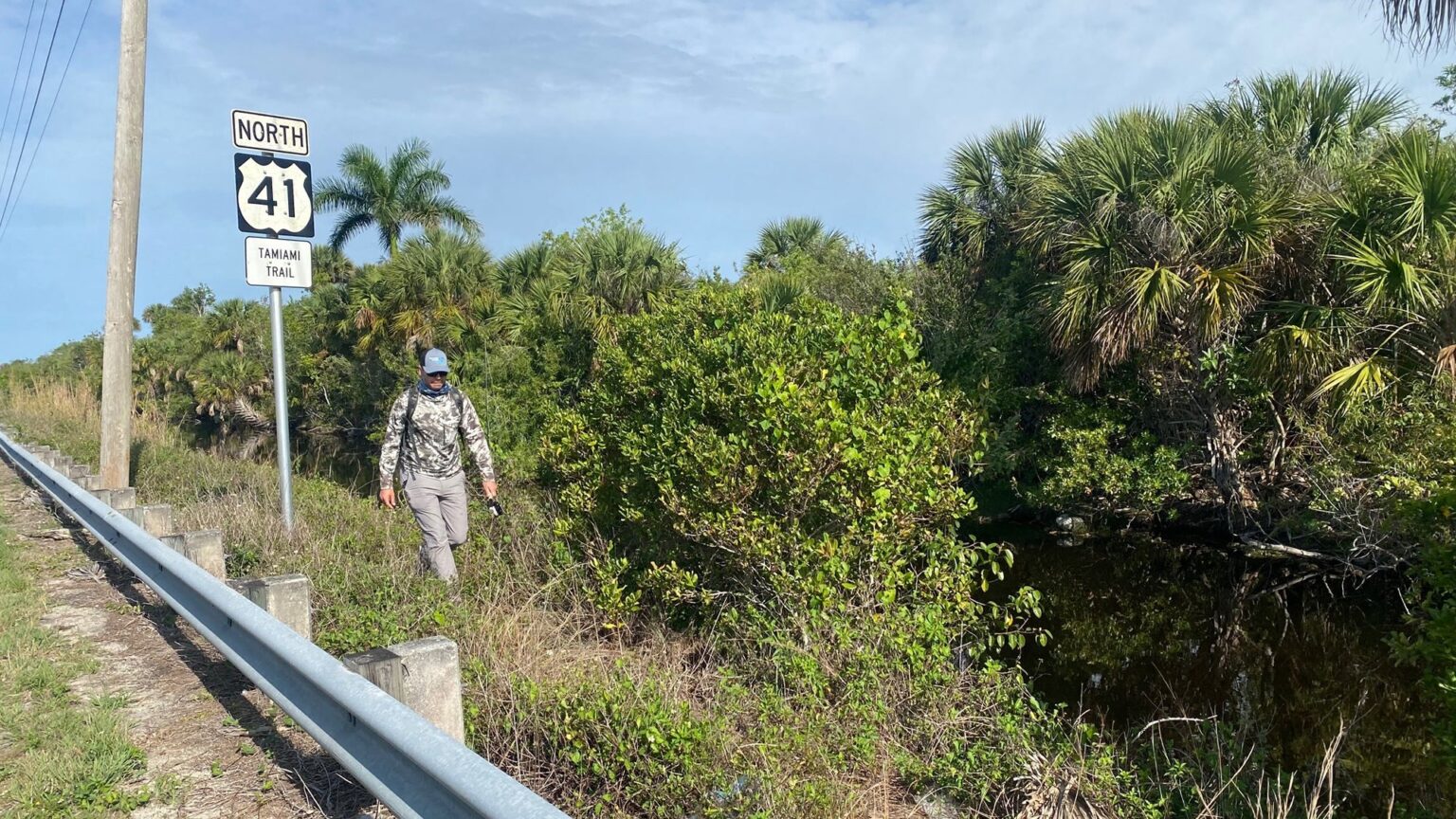
“‹We didn’t have a lot of time—maybe four hours between leaving Everglades City on Florida’s Gulf Coast and when we had to pick up my wife at the Miami airport. But why waste a few good hours? Sure, we were in the center of some of the finest fishing on the planet, with tarpon, redfish, and snook in nearly every direction. But we didn’t have time to fish from a poling skiff or charter a boat. We did, however, have time to gunkhole our way along the Tamiami Trail, stopping at the fishiest-looking spots by the road.
Fishing whenever you can, wherever you are, is a mindset I plan to employ a lot more frequently.
An Accidental Fishery
Beginning in 1915, the federal government built an extension of U.S. Highway 94 straight across the pristine wilderness of the Everglades, gashing through what would become the Big Cypress National Preserve and Everglades National Park. An estimated 2.5 million sticks of dynamite were used to blow open a canal beside the road, which is now a de facto dam on the famed River of Grass, choking off the fresh water that once flowed through the Everglades.
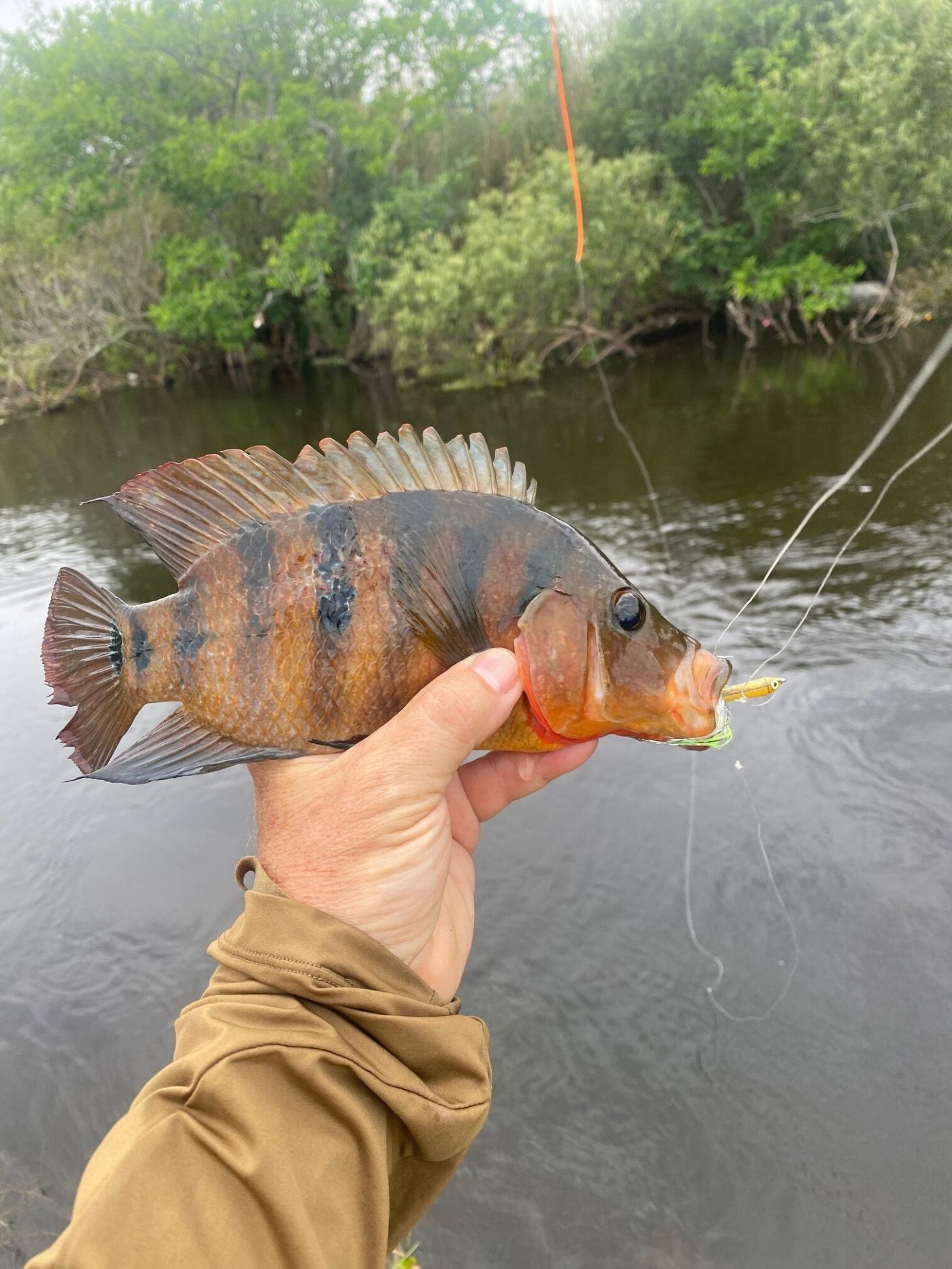
A Mayan cichild, caught on the fly. T. Edward Nickens
“‹The Tamiami Trail has proven to be an environmental tragedy, but its dark, alligator-rich waters have turned out to be a bit of an angling boon. Not only do native snook, largemouth bass, and juvenile tarpon find their way to the Tamiami Trail, but there’s a motley crew of exotic fish worthy of the Ringling Brothers Circus. Mayan cichlids are there by the bushel basket. The fish are native to South America and were first discovered in Florida Bay in 1983. Since then, they’ve spread northward like a bad case of mange. Peacock bass are a headliner too, along with jaguar guapotes, snakeheads, and oscars—yes, the same as the aquarium fish—that grow to the size of basketballs.
The Waters at Hand
It’s not primal wilderness. There were times when Nick and I were standing so close to the road that we had to time our backcasts between passing cars, and trash littered the pullouts. But there are certain charms to fishing the Tamiami Trail. Many canal sections were hemmed in with deep woods and lined with lily pads. Gators floated in the sunshine. Bridge anglers hollered back and forth in Spanish.
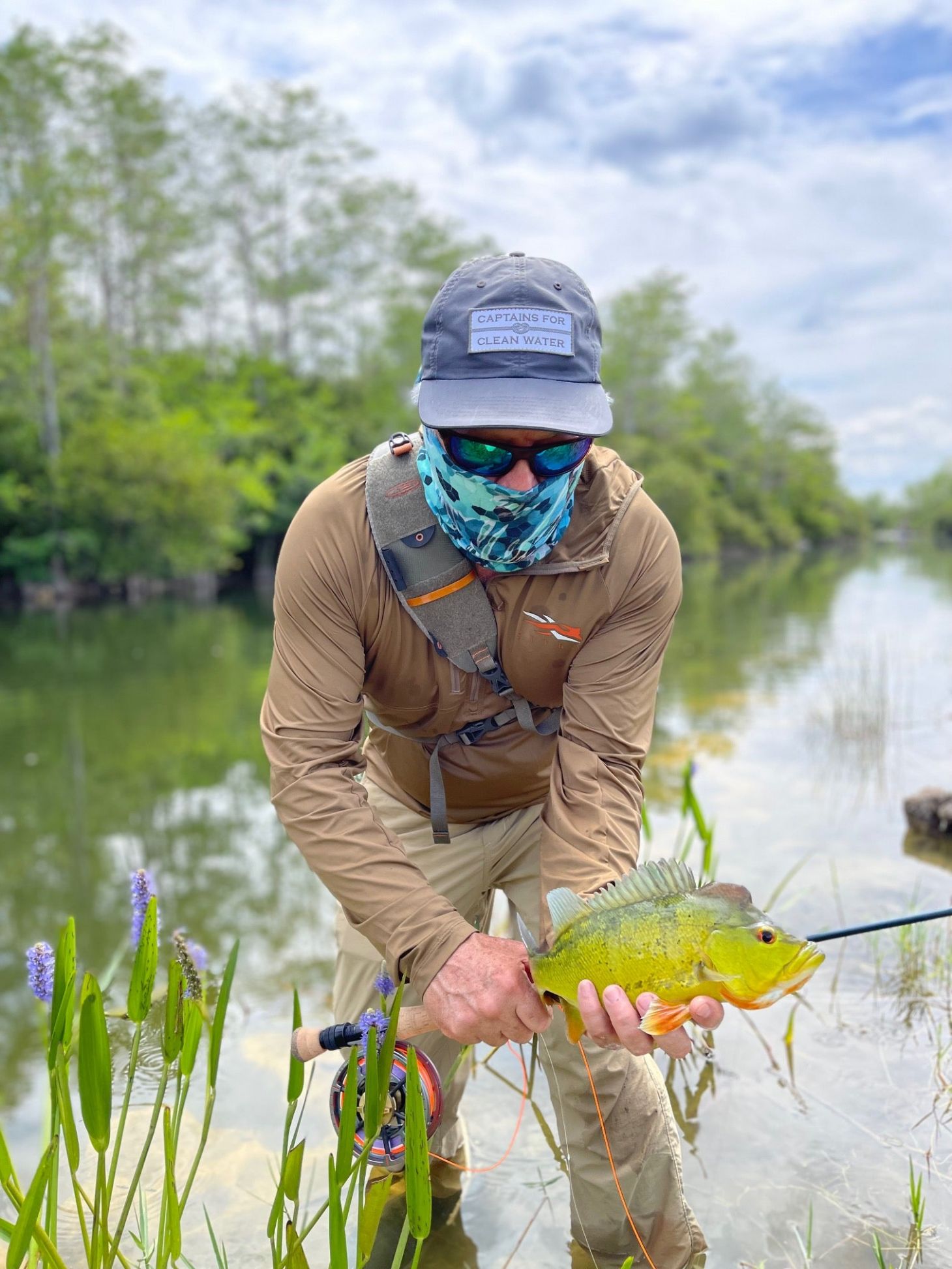
Peacock bass are a blast on fly tackle. Nick Roberts
After a tailgate lunch of five-day-old pork tenderloin and Cheetos, I chatted with a lady throwing 6-inch-long Senko worms. She and her husband were not having much luck, and when I showed her my dropper rig with a chartreuse Surf Candy tied above a small shrimpy-looking Crazy Charlie bonefish fly, she hollered over to her husband: “We need smaller lures!”
Nick and I hopped from spot to spot, fishing structure around bridges, wide coves, and anywhere else open enough to cast a fly. At one point I watched a catfish-snakehead-looking creature turn upside down and sip grass shrimp from the canalside vegetation. It wasn’t interested in what I had to offer. At one of the last places we fished, water from an outfall canal ripped through the ditch, creating a confluence not unlike one giant trout stream pouring into another, with frothy current seams, riffles, and back eddies. A great blue heron stalked one shore; an anhinga lorded over the other, its outstretched wings glistening with an oily black sheen.
“‹”Do snook hang out in current breaks like brown trout?” I hollered over to Nick.
“I have no idea what to do here,” he said.
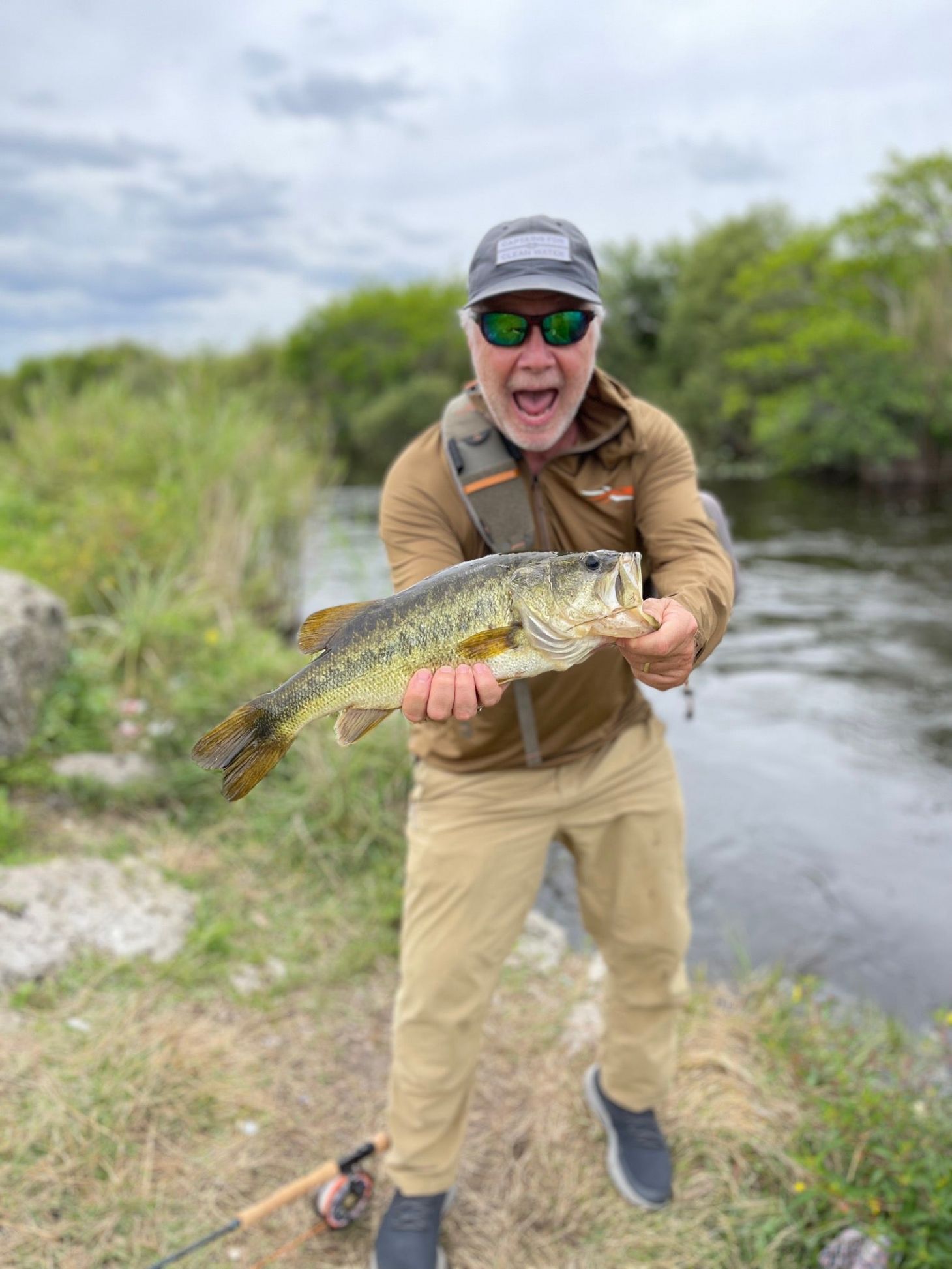
The author is giddy over the trophy of the trip—a 5-pound bass. Nick Roberts
“‹But what we did was fish the waters at hand, in the time we had. We landed cichlids, small peacock bass, and a solid 5-pound largemouth that exploded on a Clouser Minnow. We likely could have scored more consistently had we picked apart each spot and dialed in on what worked best. Instead, we hopped from place to place and never stayed anywhere long enough to get bored. We gawked at gators and fish skeletons and piles of roadside trash. We were catching fish and figuring a few things out along the way. Which sounds like a world-class few hours, if you ask me.
All new! 1871 Club Field Trips