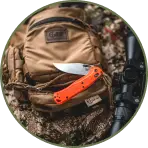
I would but one of those big bottle kits, add a trash bag, more tinder, some zip ties, a better medical kit and a good knife. I recommend the Gerber LMF 2, But some people like a more triditional looking knife. If you need a more compact kit, buy a MOLLE bag (from maxpedition.com/ blackhawh gear .com,) and stuff it with all your survival stuff from the bottled kit. Squeez out all the air to make it compact and do it to it. You can always make your own though. A big Adventure Medical Kit is not really needed in my opinion for most hunts, but get a small quality kit with supplies for blood stoping. I recomend Celox, wich is used by the military to stop bleeding. Whatever you do, get a good knife! Dont cheap out on some crap one, because when you enter the woods the gun and the knife are your best friends. Happy Hunting
I carry a small jar of Vaseline® Petroleum Jelly which is a mixture of mineral oils, paraffin and microcrystalline waxes. As some of you know Vaseline® has more uses that WD40. After cleaning the wound, use a small amount to coat the wound then cover the area. This keeps out and lets out the bad stuff also to keep the wound moist.
Vaseline® and magnesium stick is my primary fire starter rather than water proof matches. A 2x2 cotton patch saturated will burn 6 to 10 minutes.
In addition, extra batteries and ammo, GI compass and of course the Sharman’s!
Magnesium fire starter, compass, map, knife tender of some sort all stored in a stay dry pouch or case.
Plus your brain, it's free, use it it will save your life.
Clay Cooper +1 for you, Good answer!!!!
I carry non-aspirin pain reliever, adhesive bandage, alcohol prep pad, antibiotic ointment, book of matches, compass, duct tape, fire starter cube, first aid instructions and waterproof bag!!!!!!!
Use what's in current commercial kits as a guide, but customize to what activity you're doing and location you'll be in when you'll need it. You'll be able to buy the components themselves for far less than what it can be sold to you as a kit for.
While there are a lot of books that can help you figure out what that is, most of them boil down to: water (and/or purification), fire, shelter, food, signaling and first aid. A knife is (or knives are) a unifying tool between most of the above. If you have these seven areas covered for what you're doing and where you are, you'll be fine until help arrives.
Some add in orienteering equipment (compass/maps, gps, etc.) which is fine, but if you're truly 'out there' lost or hurt the general first rule is stay right where you are - let SAR find you instead of guessing the way out.
And rule number one: Let someone else know where you're going, when you'll be back, and when they should call for search and rescue if they haven't heard from you that you're back.
FWIW, my kit is: Two knives (simple $20.00 4" 'Winchester' blade from Wal-Mart, even simpler 3.5" Western hunting style knife inherited from my Dad for fine cutting,) 1 quart plastic drum canteen, 50' nylon rope, custom-bought/ assembled first aid kit, two Bic lighters (regularly checked and tested), small roll of duct tape, whistle and compass, metal coffee can (storage and water boiling,) two packs cigarettes, deck of cards and AM radio (stress relief and entertainment,) cell phone. My main activities are hiking well-laid out trails (not wilderness trekking,) and fishing. I have more than plenty to last four days until rescue (as at 24 hours overdue my family will call when I don't check back in with them.)
The best survival kit is built by the individual who is going to use it. Depending on the persons survival skills and the location it is designed for the contents of a kit change. I personaly think that a good knife fixed or folding is the most important in almost any place in the USA. You can usea knife to build a shelter, start a fire, make traps to catch food and use it like a signal mirror. A knife and the knowhow to impliment it in different ways is the best survival tool avalible. If i were constructing a kit it would have a god knife, rope or cord, a means of which to start a fire (magnisium sticks are good but can wear out, I like a fire piston which uses tinder fungus or punky wood and will light even wet) an orange trash bag, a small first aid kit, some fishing hooks with line and sinkers, a whistle and a small metal cup. This is what I would take into the woods its small and light weight. The most inportant thing is to be able to improvise and adapt because you cant carry everything you think you need into the woods with you.
One of the best commercial survival kits for under $50.00 is the Adventure Medical Pocket Survival Pack which retails for under $30.00 usually. Has everything but a knife (does have a scalpel blade) which should already be in your pocket or on your belt when you go out anyway. I recently discovered some similar products, (personal survival kits or PSK) at a website called "bepreparedtosurvive.com" which appear to be of high quality and under your price point. Another great source of info on the subject is Doug Ritter's site, "equipped to survive". He endorses the Adventure Medical kit, and, he helped design it. (Note that I am not afiliated with any of these websites. My username is similar to the one, hence the qualifier.)
I would have to say the sest is to make your own that what i have dont space blanket, water froof matches, lighter,steelwool, Fixed blade knife, pocket knife,water purification tables, ans som wire and I store it all in a small coffee can and a why a coffe can you a it does take up a little space but there seems to be a million uses for a coffe can
Make your own it will be better than any other sore bought kit you can find. I recommend the Maxpedition FR-1 pouch and a military canteen with canteen cup and stove mount. Fill the pouch with survival gear and you have a kit that will last a lifetime. Also a good sheath knife is recommended.
I would but one of those big bottle kits, add a trash bag, more tinder, some zip ties, a better medical kit and a good knife. I recommend the Gerber LMF 2, But some people like a more triditional looking knife. If you need a more compact kit, buy a MOLLE bag (from maxpedition.com/ blackhawh gear .com,) and stuff it with all your survival stuff from the bottled kit. Squeez out all the air to make it compact and do it to it. You can always make your own though. A big Adventure Medical Kit is not really needed in my opinion for most hunts, but get a small quality kit with supplies for blood stoping. I recomend Celox, wich is used by the military to stop bleeding. Whatever you do, get a good knife! Dont cheap out on some crap one, because when you enter the woods the gun and the knife are your best friends. Happy Hunting
I carry a small jar of Vaseline® Petroleum Jelly which is a mixture of mineral oils, paraffin and microcrystalline waxes. As some of you know Vaseline® has more uses that WD40. After cleaning the wound, use a small amount to coat the wound then cover the area. This keeps out and lets out the bad stuff also to keep the wound moist.
Vaseline® and magnesium stick is my primary fire starter rather than water proof matches. A 2x2 cotton patch saturated will burn 6 to 10 minutes.
In addition, extra batteries and ammo, GI compass and of course the Sharman’s!
Magnesium fire starter, compass, map, knife tender of some sort all stored in a stay dry pouch or case.
Plus your brain, it's free, use it it will save your life.
Clay Cooper +1 for you, Good answer!!!!
I carry non-aspirin pain reliever, adhesive bandage, alcohol prep pad, antibiotic ointment, book of matches, compass, duct tape, fire starter cube, first aid instructions and waterproof bag!!!!!!!
Use what's in current commercial kits as a guide, but customize to what activity you're doing and location you'll be in when you'll need it. You'll be able to buy the components themselves for far less than what it can be sold to you as a kit for.
While there are a lot of books that can help you figure out what that is, most of them boil down to: water (and/or purification), fire, shelter, food, signaling and first aid. A knife is (or knives are) a unifying tool between most of the above. If you have these seven areas covered for what you're doing and where you are, you'll be fine until help arrives.
Some add in orienteering equipment (compass/maps, gps, etc.) which is fine, but if you're truly 'out there' lost or hurt the general first rule is stay right where you are - let SAR find you instead of guessing the way out.
And rule number one: Let someone else know where you're going, when you'll be back, and when they should call for search and rescue if they haven't heard from you that you're back.
FWIW, my kit is: Two knives (simple $20.00 4" 'Winchester' blade from Wal-Mart, even simpler 3.5" Western hunting style knife inherited from my Dad for fine cutting,) 1 quart plastic drum canteen, 50' nylon rope, custom-bought/ assembled first aid kit, two Bic lighters (regularly checked and tested), small roll of duct tape, whistle and compass, metal coffee can (storage and water boiling,) two packs cigarettes, deck of cards and AM radio (stress relief and entertainment,) cell phone. My main activities are hiking well-laid out trails (not wilderness trekking,) and fishing. I have more than plenty to last four days until rescue (as at 24 hours overdue my family will call when I don't check back in with them.)
The best survival kit is built by the individual who is going to use it. Depending on the persons survival skills and the location it is designed for the contents of a kit change. I personaly think that a good knife fixed or folding is the most important in almost any place in the USA. You can usea knife to build a shelter, start a fire, make traps to catch food and use it like a signal mirror. A knife and the knowhow to impliment it in different ways is the best survival tool avalible. If i were constructing a kit it would have a god knife, rope or cord, a means of which to start a fire (magnisium sticks are good but can wear out, I like a fire piston which uses tinder fungus or punky wood and will light even wet) an orange trash bag, a small first aid kit, some fishing hooks with line and sinkers, a whistle and a small metal cup. This is what I would take into the woods its small and light weight. The most inportant thing is to be able to improvise and adapt because you cant carry everything you think you need into the woods with you.
One of the best commercial survival kits for under $50.00 is the Adventure Medical Pocket Survival Pack which retails for under $30.00 usually. Has everything but a knife (does have a scalpel blade) which should already be in your pocket or on your belt when you go out anyway. I recently discovered some similar products, (personal survival kits or PSK) at a website called "bepreparedtosurvive.com" which appear to be of high quality and under your price point. Another great source of info on the subject is Doug Ritter's site, "equipped to survive". He endorses the Adventure Medical kit, and, he helped design it. (Note that I am not afiliated with any of these websites. My username is similar to the one, hence the qualifier.)
I would have to say the sest is to make your own that what i have dont space blanket, water froof matches, lighter,steelwool, Fixed blade knife, pocket knife,water purification tables, ans som wire and I store it all in a small coffee can and a why a coffe can you a it does take up a little space but there seems to be a million uses for a coffe can
Make your own it will be better than any other sore bought kit you can find. I recommend the Maxpedition FR-1 pouch and a military canteen with canteen cup and stove mount. Fill the pouch with survival gear and you have a kit that will last a lifetime. Also a good sheath knife is recommended.
Answers (11)
I would but one of those big bottle kits, add a trash bag, more tinder, some zip ties, a better medical kit and a good knife. I recommend the Gerber LMF 2, But some people like a more triditional looking knife. If you need a more compact kit, buy a MOLLE bag (from maxpedition.com/ blackhawh gear .com,) and stuff it with all your survival stuff from the bottled kit. Squeez out all the air to make it compact and do it to it. You can always make your own though. A big Adventure Medical Kit is not really needed in my opinion for most hunts, but get a small quality kit with supplies for blood stoping. I recomend Celox, wich is used by the military to stop bleeding. Whatever you do, get a good knife! Dont cheap out on some crap one, because when you enter the woods the gun and the knife are your best friends. Happy Hunting
I carry a small jar of Vaseline® Petroleum Jelly which is a mixture of mineral oils, paraffin and microcrystalline waxes. As some of you know Vaseline® has more uses that WD40. After cleaning the wound, use a small amount to coat the wound then cover the area. This keeps out and lets out the bad stuff also to keep the wound moist.
Vaseline® and magnesium stick is my primary fire starter rather than water proof matches. A 2x2 cotton patch saturated will burn 6 to 10 minutes.
In addition, extra batteries and ammo, GI compass and of course the Sharman’s!
flint knife and a compass would be mine . also like mr coopers vaseline and magnesium stick info learned something new
Magnesium fire starter, knife, and compass would deffinately be in it. I like Clay's kit too.....
Magnesium fire starter, compass, map, knife tender of some sort all stored in a stay dry pouch or case.
Plus your brain, it's free, use it it will save your life.
Clay Cooper +1 for you, Good answer!!!!
I carry non-aspirin pain reliever, adhesive bandage, alcohol prep pad, antibiotic ointment, book of matches, compass, duct tape, fire starter cube, first aid instructions and waterproof bag!!!!!!!
The kit you build yourself.
Use what's in current commercial kits as a guide, but customize to what activity you're doing and location you'll be in when you'll need it. You'll be able to buy the components themselves for far less than what it can be sold to you as a kit for.
While there are a lot of books that can help you figure out what that is, most of them boil down to: water (and/or purification), fire, shelter, food, signaling and first aid. A knife is (or knives are) a unifying tool between most of the above. If you have these seven areas covered for what you're doing and where you are, you'll be fine until help arrives.
Some add in orienteering equipment (compass/maps, gps, etc.) which is fine, but if you're truly 'out there' lost or hurt the general first rule is stay right where you are - let SAR find you instead of guessing the way out.
And rule number one: Let someone else know where you're going, when you'll be back, and when they should call for search and rescue if they haven't heard from you that you're back.
FWIW, my kit is: Two knives (simple $20.00 4" 'Winchester' blade from Wal-Mart, even simpler 3.5" Western hunting style knife inherited from my Dad for fine cutting,) 1 quart plastic drum canteen, 50' nylon rope, custom-bought/ assembled first aid kit, two Bic lighters (regularly checked and tested), small roll of duct tape, whistle and compass, metal coffee can (storage and water boiling,) two packs cigarettes, deck of cards and AM radio (stress relief and entertainment,) cell phone. My main activities are hiking well-laid out trails (not wilderness trekking,) and fishing. I have more than plenty to last four days until rescue (as at 24 hours overdue my family will call when I don't check back in with them.)
Hope that helps!
The best survival kit is built by the individual who is going to use it. Depending on the persons survival skills and the location it is designed for the contents of a kit change. I personaly think that a good knife fixed or folding is the most important in almost any place in the USA. You can usea knife to build a shelter, start a fire, make traps to catch food and use it like a signal mirror. A knife and the knowhow to impliment it in different ways is the best survival tool avalible. If i were constructing a kit it would have a god knife, rope or cord, a means of which to start a fire (magnisium sticks are good but can wear out, I like a fire piston which uses tinder fungus or punky wood and will light even wet) an orange trash bag, a small first aid kit, some fishing hooks with line and sinkers, a whistle and a small metal cup. This is what I would take into the woods its small and light weight. The most inportant thing is to be able to improvise and adapt because you cant carry everything you think you need into the woods with you.
The cheapest and most effective survival kit is a homemade one!
One of the best commercial survival kits for under $50.00 is the Adventure Medical Pocket Survival Pack which retails for under $30.00 usually. Has everything but a knife (does have a scalpel blade) which should already be in your pocket or on your belt when you go out anyway. I recently discovered some similar products, (personal survival kits or PSK) at a website called "bepreparedtosurvive.com" which appear to be of high quality and under your price point. Another great source of info on the subject is Doug Ritter's site, "equipped to survive". He endorses the Adventure Medical kit, and, he helped design it. (Note that I am not afiliated with any of these websites. My username is similar to the one, hence the qualifier.)
I would have to say the sest is to make your own that what i have dont space blanket, water froof matches, lighter,steelwool, Fixed blade knife, pocket knife,water purification tables, ans som wire and I store it all in a small coffee can and a why a coffe can you a it does take up a little space but there seems to be a million uses for a coffe can
Make your own it will be better than any other sore bought kit you can find. I recommend the Maxpedition FR-1 pouch and a military canteen with canteen cup and stove mount. Fill the pouch with survival gear and you have a kit that will last a lifetime. Also a good sheath knife is recommended.
Post an Answer
I would but one of those big bottle kits, add a trash bag, more tinder, some zip ties, a better medical kit and a good knife. I recommend the Gerber LMF 2, But some people like a more triditional looking knife. If you need a more compact kit, buy a MOLLE bag (from maxpedition.com/ blackhawh gear .com,) and stuff it with all your survival stuff from the bottled kit. Squeez out all the air to make it compact and do it to it. You can always make your own though. A big Adventure Medical Kit is not really needed in my opinion for most hunts, but get a small quality kit with supplies for blood stoping. I recomend Celox, wich is used by the military to stop bleeding. Whatever you do, get a good knife! Dont cheap out on some crap one, because when you enter the woods the gun and the knife are your best friends. Happy Hunting
I carry a small jar of Vaseline® Petroleum Jelly which is a mixture of mineral oils, paraffin and microcrystalline waxes. As some of you know Vaseline® has more uses that WD40. After cleaning the wound, use a small amount to coat the wound then cover the area. This keeps out and lets out the bad stuff also to keep the wound moist.
Vaseline® and magnesium stick is my primary fire starter rather than water proof matches. A 2x2 cotton patch saturated will burn 6 to 10 minutes.
In addition, extra batteries and ammo, GI compass and of course the Sharman’s!
flint knife and a compass would be mine . also like mr coopers vaseline and magnesium stick info learned something new
Magnesium fire starter, knife, and compass would deffinately be in it. I like Clay's kit too.....
Magnesium fire starter, compass, map, knife tender of some sort all stored in a stay dry pouch or case.
Plus your brain, it's free, use it it will save your life.
Clay Cooper +1 for you, Good answer!!!!
I carry non-aspirin pain reliever, adhesive bandage, alcohol prep pad, antibiotic ointment, book of matches, compass, duct tape, fire starter cube, first aid instructions and waterproof bag!!!!!!!
The kit you build yourself.
Use what's in current commercial kits as a guide, but customize to what activity you're doing and location you'll be in when you'll need it. You'll be able to buy the components themselves for far less than what it can be sold to you as a kit for.
While there are a lot of books that can help you figure out what that is, most of them boil down to: water (and/or purification), fire, shelter, food, signaling and first aid. A knife is (or knives are) a unifying tool between most of the above. If you have these seven areas covered for what you're doing and where you are, you'll be fine until help arrives.
Some add in orienteering equipment (compass/maps, gps, etc.) which is fine, but if you're truly 'out there' lost or hurt the general first rule is stay right where you are - let SAR find you instead of guessing the way out.
And rule number one: Let someone else know where you're going, when you'll be back, and when they should call for search and rescue if they haven't heard from you that you're back.
FWIW, my kit is: Two knives (simple $20.00 4" 'Winchester' blade from Wal-Mart, even simpler 3.5" Western hunting style knife inherited from my Dad for fine cutting,) 1 quart plastic drum canteen, 50' nylon rope, custom-bought/ assembled first aid kit, two Bic lighters (regularly checked and tested), small roll of duct tape, whistle and compass, metal coffee can (storage and water boiling,) two packs cigarettes, deck of cards and AM radio (stress relief and entertainment,) cell phone. My main activities are hiking well-laid out trails (not wilderness trekking,) and fishing. I have more than plenty to last four days until rescue (as at 24 hours overdue my family will call when I don't check back in with them.)
Hope that helps!
The best survival kit is built by the individual who is going to use it. Depending on the persons survival skills and the location it is designed for the contents of a kit change. I personaly think that a good knife fixed or folding is the most important in almost any place in the USA. You can usea knife to build a shelter, start a fire, make traps to catch food and use it like a signal mirror. A knife and the knowhow to impliment it in different ways is the best survival tool avalible. If i were constructing a kit it would have a god knife, rope or cord, a means of which to start a fire (magnisium sticks are good but can wear out, I like a fire piston which uses tinder fungus or punky wood and will light even wet) an orange trash bag, a small first aid kit, some fishing hooks with line and sinkers, a whistle and a small metal cup. This is what I would take into the woods its small and light weight. The most inportant thing is to be able to improvise and adapt because you cant carry everything you think you need into the woods with you.
The cheapest and most effective survival kit is a homemade one!
One of the best commercial survival kits for under $50.00 is the Adventure Medical Pocket Survival Pack which retails for under $30.00 usually. Has everything but a knife (does have a scalpel blade) which should already be in your pocket or on your belt when you go out anyway. I recently discovered some similar products, (personal survival kits or PSK) at a website called "bepreparedtosurvive.com" which appear to be of high quality and under your price point. Another great source of info on the subject is Doug Ritter's site, "equipped to survive". He endorses the Adventure Medical kit, and, he helped design it. (Note that I am not afiliated with any of these websites. My username is similar to the one, hence the qualifier.)
I would have to say the sest is to make your own that what i have dont space blanket, water froof matches, lighter,steelwool, Fixed blade knife, pocket knife,water purification tables, ans som wire and I store it all in a small coffee can and a why a coffe can you a it does take up a little space but there seems to be a million uses for a coffe can
Make your own it will be better than any other sore bought kit you can find. I recommend the Maxpedition FR-1 pouch and a military canteen with canteen cup and stove mount. Fill the pouch with survival gear and you have a kit that will last a lifetime. Also a good sheath knife is recommended.
Post an Answer