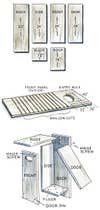
America's housing shortage extends beyond the inner cities and suburbs and into the wooded marshes and riverbottoms, where wood ducks (as well as goldeneyes and buffleheads) compete for an ever decreasing supply of nesting sites in natural tree cavities. You can help—and join other conservation-minded sportsmen—by building a simple nest box. If properly placed, it will provide a home for generations of ducks, and ducks for generations of sportsmen. —DAVE HURTEAU
[STEP 1] Start with a 12-foot plank of 1×10 lumber—cedar is best; pine will work. Cut it to the lengths shown at right.
[STEP 2] On the outer face of the front, cut an oval-shaped entry hole, 4 ½ inches wide and 3 ½ inches high. Then turn the board over, and starting just below the hole, score the interior face with shallow horizontal cuts about 1 inch apart. These will give ducklings a toe-hold for climbing out of the box.
[STEP 3] Attach the side piece with four 1 5/8-inch wood screws driven through the back as shown. The back should extend beyond the side by 3 inches on top and bottom.
[STEP 4] Using a ½-inch bit, drill five holes in the floor for drainage. Attach the floor with two screws through the back and two through the side. Then attach the front to the side and floor.
[STEP 5] Bevel the top outer edge of the door, or round it with a sander or file. Then attach the door at the top only with one screw through the front board and one through the back. These screws will act as hinges, allowing the door to swing open. Drill a small hole through the bottom right of the front piece and into the side of the door. Insert a nail of a slightly smaller diameter to pin the door shut.
[STEP 6] Attach the roof to the back, side, and front.
[STEP 7] Finally, put 6 inches of wood shavings (not sawdust) in the bottom and place the box directly above the water or along the water's edge by fixing it to a tree or a metal pole. A conical metal flange or other predator guard is a good idea (see ducks.org/ conservation/duck_box_plans.pdf). Keep the box at a height you can reach, say 5 feet, as you will need to replace the wood shavings yearly.
Comments (4)
This'll be a perfect project for this winter. Thanks!
I recently made (for the first time) 5 wood duck boxes out of cypress wood using the wood duck box plans. I mounted the boxes to 4x4 treated pine, 8' long. The boxes were slightly tilted so the rain would drain from the roof. Since early March is their nesting time in the south(that's what I have read), I finished mounting the boxes by late Feb. The hardest part was the critter guard mounted just below the box and made out of tin. I used two pieces of tin, 2' x 3', for each box, cut from a 12' original piece (from Lowe's). I mounted each piece to opposite sides of the 4x4 with wood screws and then used short, self-tapping, sheet metal screws to mount both pieces of tin together. The gap between the two sheets of tin was filled with foam sealent (normally used to insulate large gaps) to keep snakes away. I hope all the works, because I think the wood duck is worth it.
sounds like a very worthwhile project. The tree I want to mount this on is about 15' from the water but will be facing due west. My concern is that with the afternoon sun reflecting off the water will it be to hot in the box?? anybody have an opinion??
The picture in the maggazine has the shows the box made of what looks like plywood . Is this accceptable?
Can used, painted wood work?
For the "critter guard", used soda cans worked over with a pair of sissors could also work, the birds won't care.
Post a Comment
This'll be a perfect project for this winter. Thanks!
I recently made (for the first time) 5 wood duck boxes out of cypress wood using the wood duck box plans. I mounted the boxes to 4x4 treated pine, 8' long. The boxes were slightly tilted so the rain would drain from the roof. Since early March is their nesting time in the south(that's what I have read), I finished mounting the boxes by late Feb. The hardest part was the critter guard mounted just below the box and made out of tin. I used two pieces of tin, 2' x 3', for each box, cut from a 12' original piece (from Lowe's). I mounted each piece to opposite sides of the 4x4 with wood screws and then used short, self-tapping, sheet metal screws to mount both pieces of tin together. The gap between the two sheets of tin was filled with foam sealent (normally used to insulate large gaps) to keep snakes away. I hope all the works, because I think the wood duck is worth it.
sounds like a very worthwhile project. The tree I want to mount this on is about 15' from the water but will be facing due west. My concern is that with the afternoon sun reflecting off the water will it be to hot in the box?? anybody have an opinion??
The picture in the maggazine has the shows the box made of what looks like plywood . Is this accceptable?
Can used, painted wood work?
For the "critter guard", used soda cans worked over with a pair of sissors could also work, the birds won't care.
Post a Comment