Close Menu
  • Stories
    • Hunting
      • Big Game Hunting
        • Elk Hunting
        • Bear Hunting
      • Deer Hunting
        • Whitetail Hunting
        • Mule Deer Hunting
      • Predator Hunting
        • Bobcat Hunting
      • Small Game Hunting
      • Bird Hunting
      • Dogs
        • Hunting Dogs
        • Canine Gear & Accessories
      • Turkey Hunting
      • Waterfowl Hunting
        • Duck Hunting
    • Fishing
      • Freshwater Fishing
        • Bass Fishing
        • Catfishing
        • Trout Fishing
        • Pike & Muskie Fishing
      • Saltwater Fishing
        • Striped Bass Fishing
      • Ice Fishing
      • Fly Fishing
    • Guns
      • Ammo
        • Handguns Ammo
        • Shotguns Ammo
        • Rifles Ammo
      • Rifles
      • Handguns
      • Shotguns
    • Survival
      • Survival Food
      • Wilderness Survival
      • All Survival
    • Conservation
      • Hunting Conservation
      • Fishing Conservation
      • Public Lands & Waters
      • Wildlife Conservation
    • Cooking
      • Recipes
  • Outdoor Gear
    • Hunting
      • Big Game Hunting
      • Bird Hunting
      • Bow Hunting
        • Crossbows
        • Compound Bows
      • Boots
      • Hunting Calls & Decoys
      • Knives
      • Hunting Apparel & Accessories
      • Optics
        • Binoculars
        • Scopes and Sights
        • Rangefinders
      • Trail Cameras
      • Waterfowl Hunting
      • Turkey Hunting
    • Fishing
      • Baits, Lures, and Flies
      • Fishing Reels
      • Fishing Rods
      • Fly Fishing
    • Guns
      • Ammo
        • Shotgun Ammo
        • Rifle Ammo
        • Handgun Ammo
      • Handguns
      • Shotguns
      • Rifles
    • Camping & Outdoor Rec
      • Auto & Truck
      • Camping Gear
      • Hiking & Backpacking
    • Gift Guides
    • Cooking
      • Cooking Gear
  • Shop
    • Shop Field & Stream
      • F&S Shop
      • Hunting
      • Fishing
      • Camping & Hiking
      • Clothing
      • Footwear
      • Gear
      • Outdoor Living
      • Member Merch
      • Journals
      • Gift Cards
      • Membership Gift Card
      • Merchandise Gift Card
    • Shop Field & Stream at:
      • Tractor Supply Co.
      • Amazon
      • Moultrie
      • Yuengling
      • Old Wood Signs
      • Best Home Furnishings
      • Sugarlands Distilling Co.
      • Gokey
      • WearSPF
  • F&S TV
  • Membership
    • Subscription Plans
    • Free Membership
    • Member Login / Create an Account
    • Gift a Subscription
      • Premium Membership
      • Print Membership
Search
Facebook X (Twitter) Instagram
Join the 1871 Club to access two limited-edition Father's Day gifts · LEARN MORE
Field & Stream
  • Stories
    • Hunting
      • Big Game Hunting
        • Elk Hunting
        • Bear Hunting
      • Deer Hunting
        • Whitetail Hunting
        • Mule Deer Hunting
      • Predator Hunting
        • Bobcat Hunting
      • Small Game Hunting
      • Bird Hunting
      • Dogs
        • Hunting Dogs
        • Canine Gear & Accessories
      • Turkey Hunting
      • Waterfowl Hunting
        • Duck Hunting
    • Fishing
      • Freshwater Fishing
        • Bass Fishing
        • Catfishing
        • Trout Fishing
        • Pike & Muskie Fishing
      • Saltwater Fishing
        • Striped Bass Fishing
      • Ice Fishing
      • Fly Fishing
    • Guns
      • Ammo
        • Handguns Ammo
        • Shotguns Ammo
        • Rifles Ammo
      • Rifles
      • Handguns
      • Shotguns
    • Survival
      • Survival Food
      • Wilderness Survival
      • All Survival
    • Conservation
      • Hunting Conservation
      • Fishing Conservation
      • Public Lands & Waters
      • Wildlife Conservation
    • Cooking
      • Recipes
  • Outdoor Gear
    • Hunting
      • Big Game Hunting
      • Bird Hunting
      • Bow Hunting
        • Crossbows
        • Compound Bows
      • Boots
      • Hunting Calls & Decoys
      • Knives
      • Hunting Apparel & Accessories
      • Optics
        • Binoculars
        • Scopes and Sights
        • Rangefinders
      • Trail Cameras
      • Waterfowl Hunting
      • Turkey Hunting
    • Fishing
      • Baits, Lures, and Flies
      • Fishing Reels
      • Fishing Rods
      • Fly Fishing
    • Guns
      • Ammo
        • Shotgun Ammo
        • Rifle Ammo
        • Handgun Ammo
      • Handguns
      • Shotguns
      • Rifles
    • Camping & Outdoor Rec
      • Auto & Truck
      • Camping Gear
      • Hiking & Backpacking
    • Gift Guides
    • Cooking
      • Cooking Gear
  • Shop
    • Shop Field & Stream
      • F&S Shop
      • Hunting
      • Fishing
      • Camping & Hiking
      • Clothing
      • Footwear
      • Gear
      • Outdoor Living
      • Member Merch
      • Journals
      • Gift Cards
      • Membership Gift Card
      • Merchandise Gift Card
    • Shop Field & Stream at:
      • Tractor Supply Co.
      • Amazon
      • Moultrie
      • Yuengling
      • Old Wood Signs
      • Best Home Furnishings
      • Sugarlands Distilling Co.
      • Gokey
      • WearSPF
  • F&S TV
  • Membership
    • Subscription Plans
    • Free Membership
    • Member Login / Create an Account
    • Gift a Subscription
      • Premium Membership
      • Print Membership
JOIN THE 1871 CLUB
Join the 1871 Club Today - Spring Journal Ships in April
Field & Stream
Home / Outdoor Gear / Guns / Ammo / Rifle Ammo / How Big Game Bullets Work
Rifle Ammo

How Big Game Bullets Work

Richard MannBy Richard MannJanuary 23, 2026

FIELD & STREAM NEWSLETTERS

ALL F&S NEWSLETTERS

I’m convinced that a lot of hunters don’t fully understand how big-game bullets work. This is partly because hunters can’t see a bullet at work, and partly because bullet marketing hype can be misleading. Also, many hunters just shoot their deer and drag them out of the woods, with little worry or interest in exactly how the bullet made it all possible. Two decades ago, I patented a bullet-testing media, and it involved a lot of bullet evalauation and work with bullet manufacturers. That, combined with a bunch of field experience, taught me a lot about bullets, so let me try to demystify how they work.

Instead of a complicated physics lesson, let’s start with some great advice from F&S rifles editor, David E. Petzal, who once wrote, “”¦the more damage you do with the first shot, the better things are going to turn out, at least for you.” I don’t agree with all of Petzal’s opinions on bullets, but there’s no denying that the more tissue damage your bullet inflicts (preferably on the first shot), the quicker and more humane the kill.

But you need to know how to manage the damage. Some suggest using a big ol’ magnum and to just knock the hell out of whatever you’re shooting. This can work, but magnums knock the hell out of you too. Anticipation of stiff recoil makes accurate shooting difficult. What generally works better is to shoot a manageable cartridge and to hit the animal in the right spot with a bullet that you know will upset enough and penetrate sufficiently to get the job done. That’s why choosing the right big-game bullet for a given situation is so important. So, let’s look at the options.

Types of Big Game Bullets
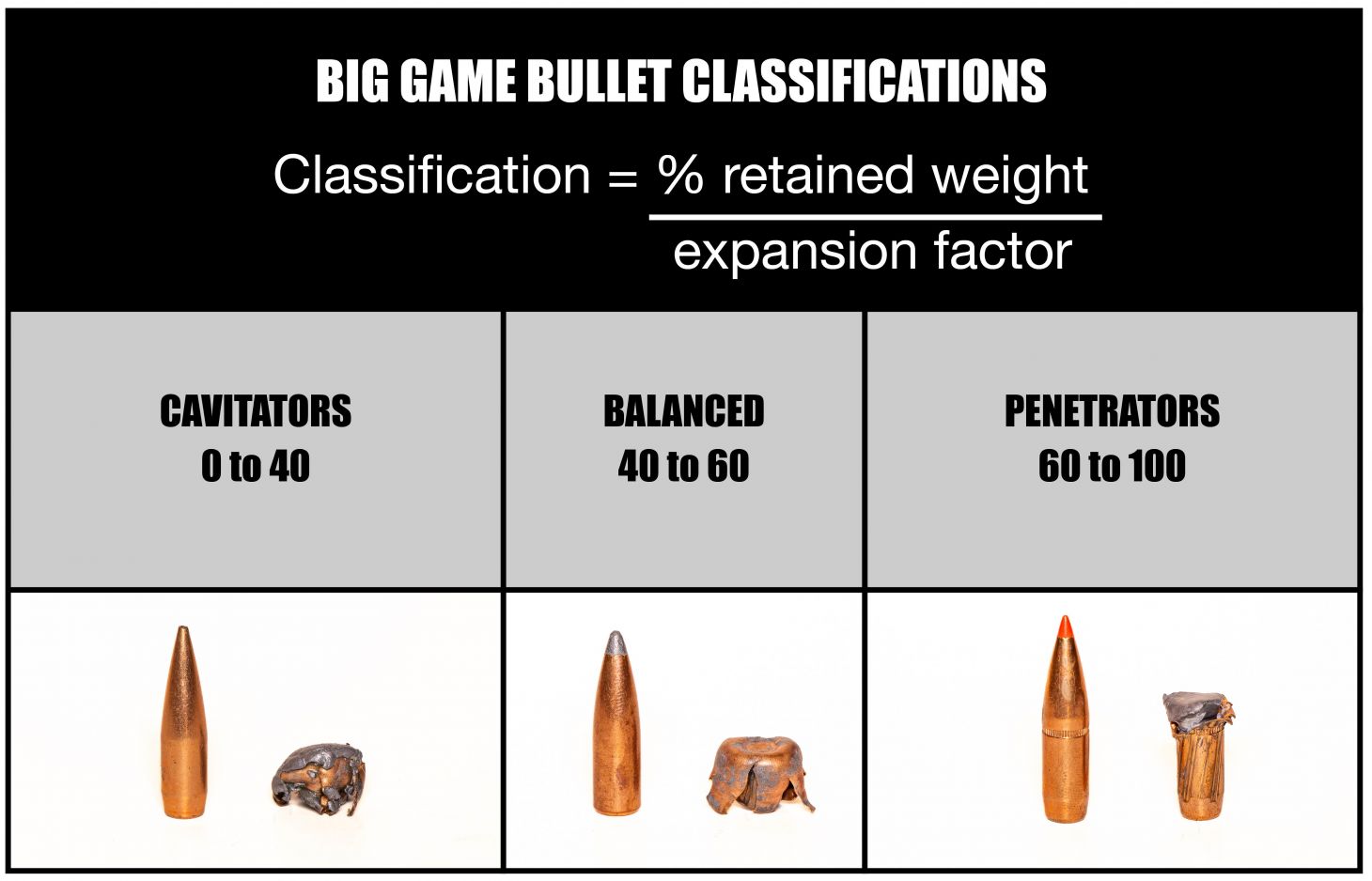
Chart showing three types of big game bullets.
Cavitating bullets are quick-expanders that retain less weight; balanced bullets are controlled expanders that hold together more, and penetrators expand the least and retain a lot of weight for maximum penetration.

One of easiest ways to understand how big-game bullets work is to divide them into categories that include cavitating, penetrating, and balanced. Cavitating bullets are what many hunters refer to as “quick-expanders,” like your typical soft-point deer bullet. Penetrating bullets are what people often call “tough” bullets; they hold together and retain a lot of weight. Balanced bullets are, as you’d expect, represent a happy medium, with controlled expansion and good weight retention and therefore penetration.

There is a simple math equation for figuring out what category a bullet belongs in; you simply take a bullet recovered from a big-game animal or test media and divide the percentage of weight retained by the bullet’s expansion factor. (Expansion factor is the bullet’s recovered diameter divided by its caliber.) The result will be somewhere between 0 and 100 and will position the bullet in one of the three categories, as the chart above details.

There is an x-factor, however, and it is impact velocity. Velocity is what creates the energy that makes bullets work. Depending on impact velocity, some bullets can fall within all three categories. The goal of bullet engineers is to create a bullet that will live within in a single desired category over the widest velocity range.
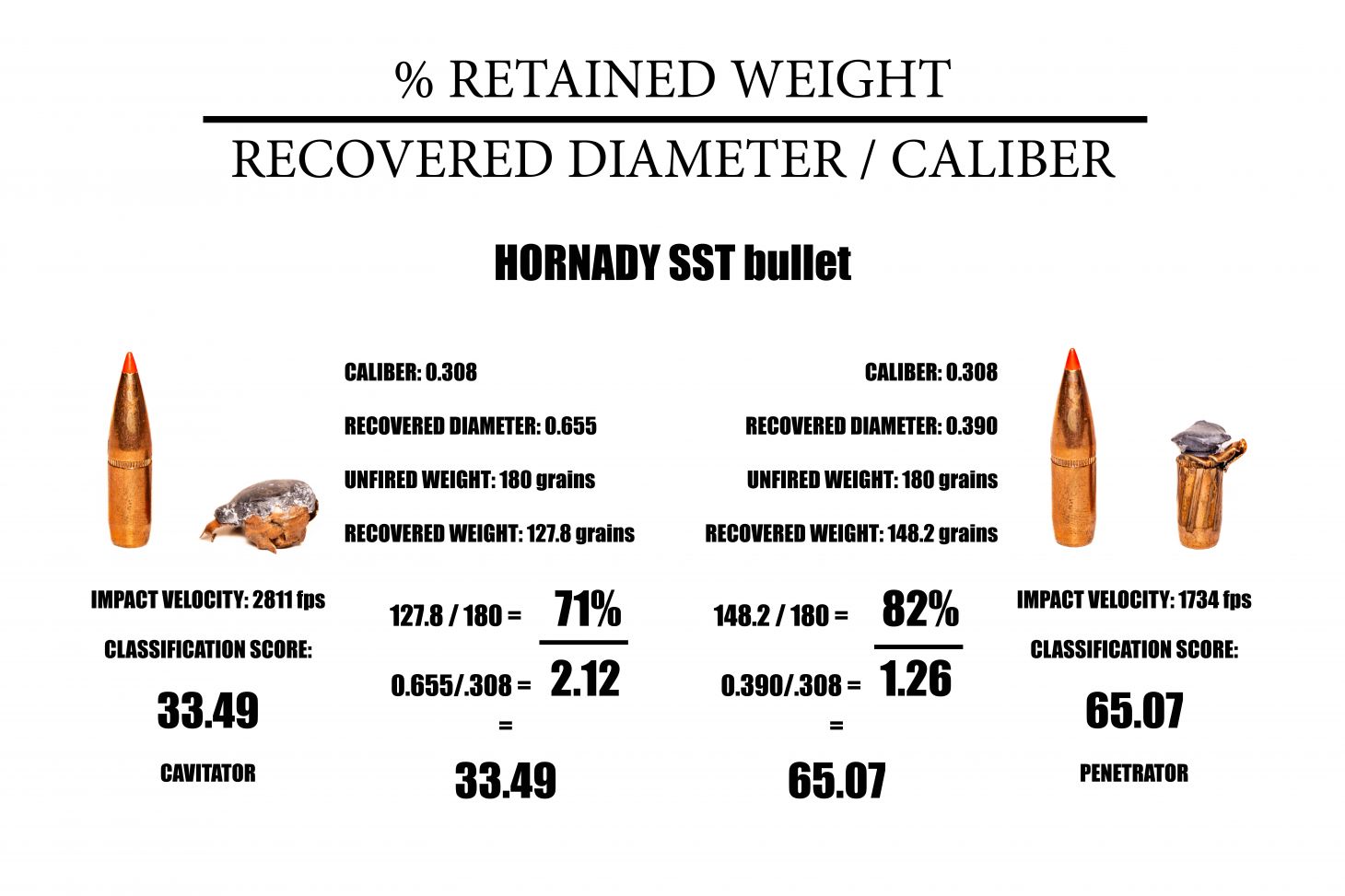
Chart showing how the same bullet performs based on impact velocity.
This chart show how the same bullet—in this case a Hornady SST—can be classified differently depending on impact velocity.

For example, a Hornady SST bullet impacting slower than about 1800 fps will hardly deform at all and will penetrate very deep. One impacting at about 2800 fps and faster will create a lot of cavitation and make a nasty wound cavity but with less penetration. Somewhere in between those velocities, an SST bullet will work in a more balanced manner, with measurable tissue destruction and decent penetration. As a hunter, if you want reliable bullet penetration, you need to consider how fast your bullet will be traveling at the distance of your target.

How Energy Affects Bullet Performance

When a bullet impacts an animal, it begins to deform instantly. This deformation—commonly called expansion—happens over a very short distance. Most bullets finish shape shifting before penetrating 6 inches, and even before rotating a full turn inside the animal. The materials used to make the bullet, how it’s designed, and its impact velocity, determine how this shape shifting plays out. Many hunters like to reference kinetic energy when it comes to terminal performance, and this where that energy comes into play.
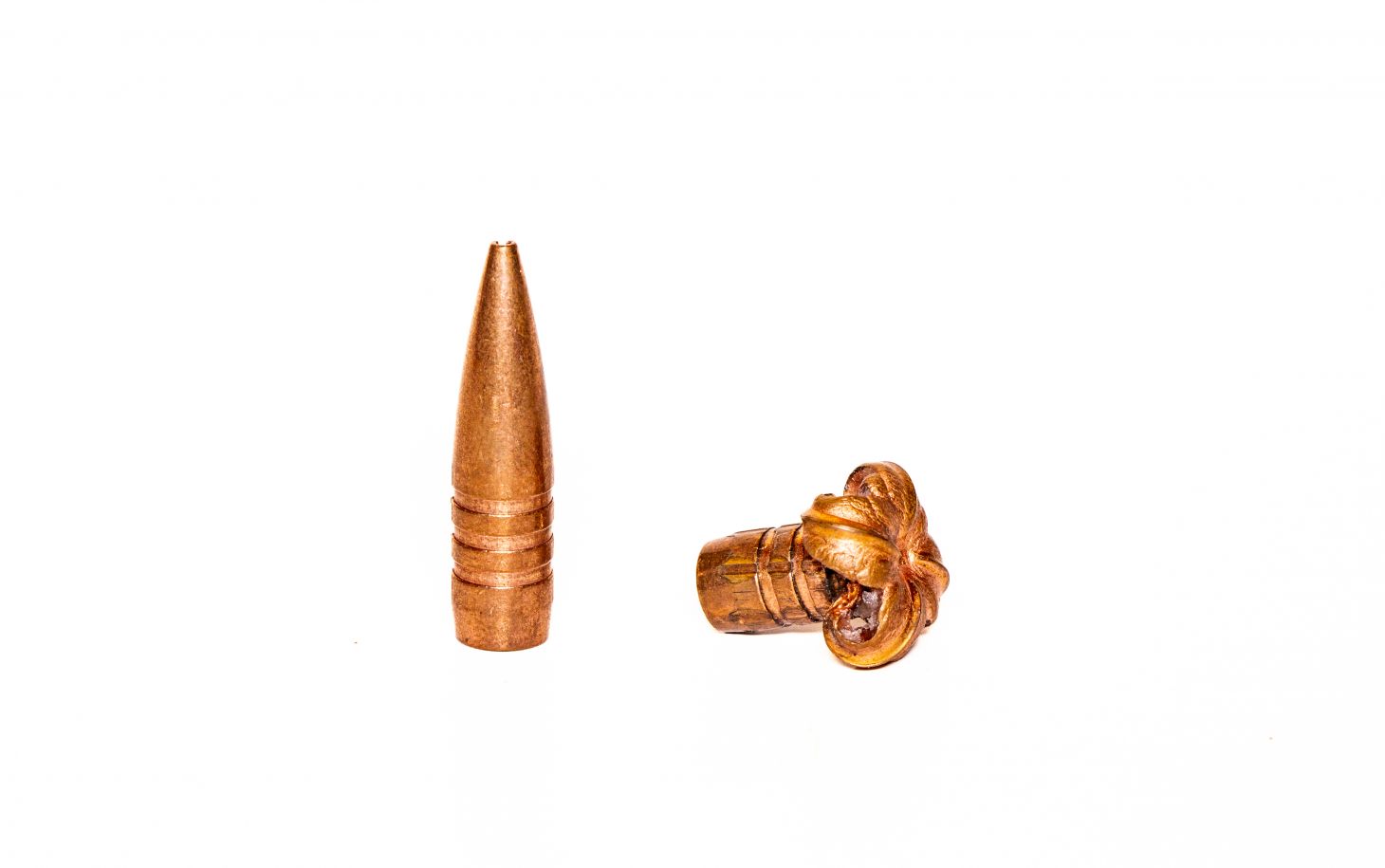
An unfired big game bullet next to a fired one, both on a white background.
Barnes Triple Shock bullets generally double in diameter after impact and retain all their weight. This positions them perfectly as a balanced bullet. (Photo/Richard Mann)

For example, a mono-metal bullet like the Barnes Triple Shock will fully deform almost instantly, and it only takes about 50% of the bullet’s energy to fuel this transformation. After upset, it will still have all or most of its weight and about half its energy left. This allows it to penetrate well, and within its ideal velocity range, it acts as a balanced bullet. Bonded and partitioned bullets act similarly, but because of their softer lead and lead-alloy cores, they’ll have a bit less weight and energy left over after deformation.

More traditional jacketed lead-core bullets take a bit longer to fully deform because the independent jacket and soft lead core remain malleable at slower velocities. These bullets shed weight and energy to deeper depths, and after deformation may have as little as 50% of their weight and only 20% of their energy remaining. These bullets won’t penetrate as deep, but the energy used creates a lot of tissue damage. These are cavitating bullets.
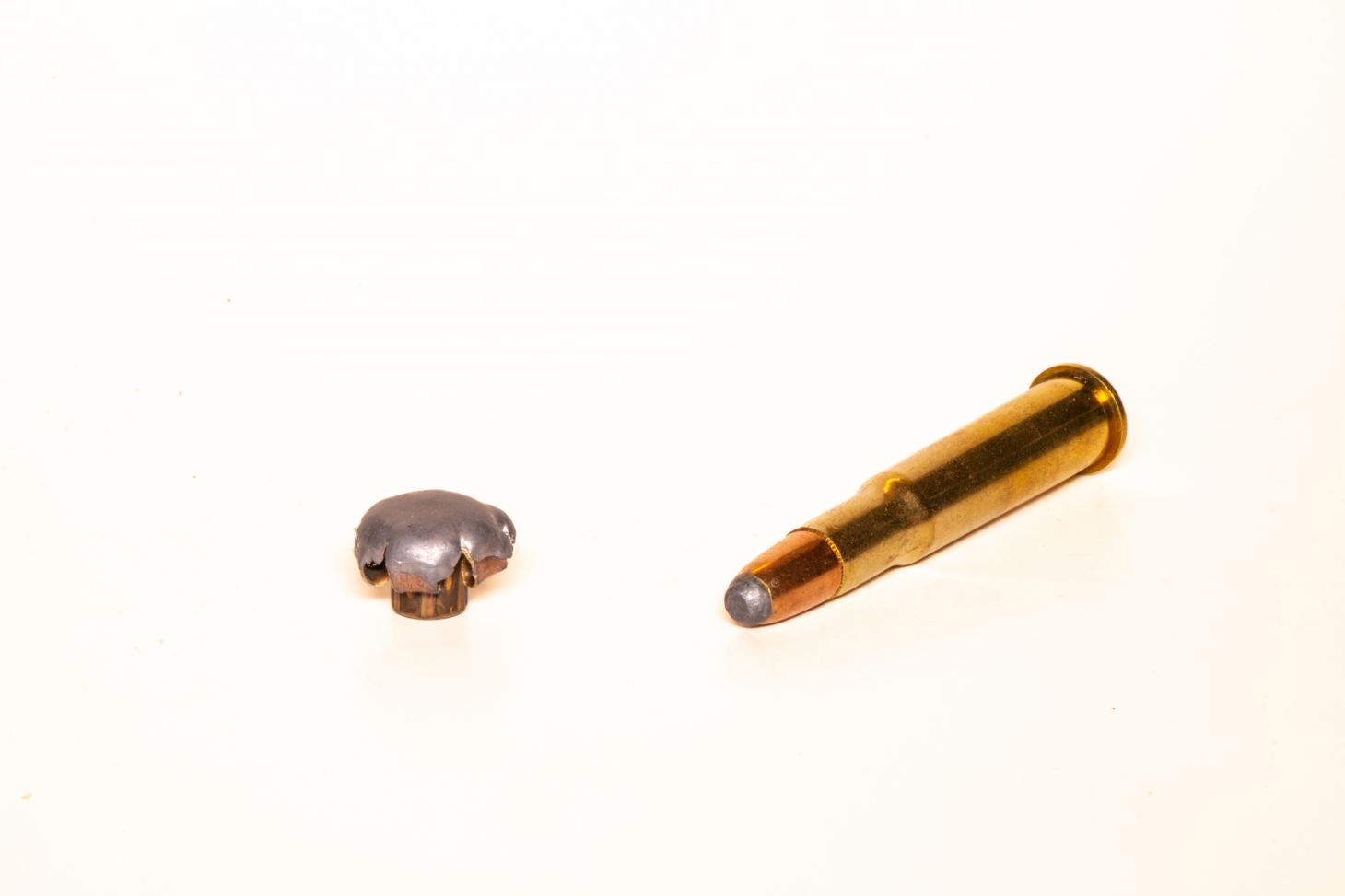
A 30-30 cartridge with a fired bullet on a white background.
Though they often act like cavitating bullets in high velocity cartridges, when used in slow velocity cartridges like the 30-30, conventional lead core bullets can provide a balanced performance.

As for penetrating bullets, some are designed not to deform, like the solids used for dangerous game hunting. But keep in mind that bullet that is made to deform at typical impact velocities can fail to do so and essentially become a penetrating bullet when they impact at a velocity slower than necessary to cause measurable deformation. This usually occurs when the distance to the target is too far.

Exceptions to the Big-Game-Bullet Rules

As with everything, there are exceptions. Some traditional jacketed bullets for low-velocity cartridges deliver a more balanced performance within their ideal impact velocity range. This is especially true with bullets loaded for cartridges like the 360 Buckhammer or 45-70 Government. These cartridges just don’t have the velocity to push these bullets into the cavitating classification.
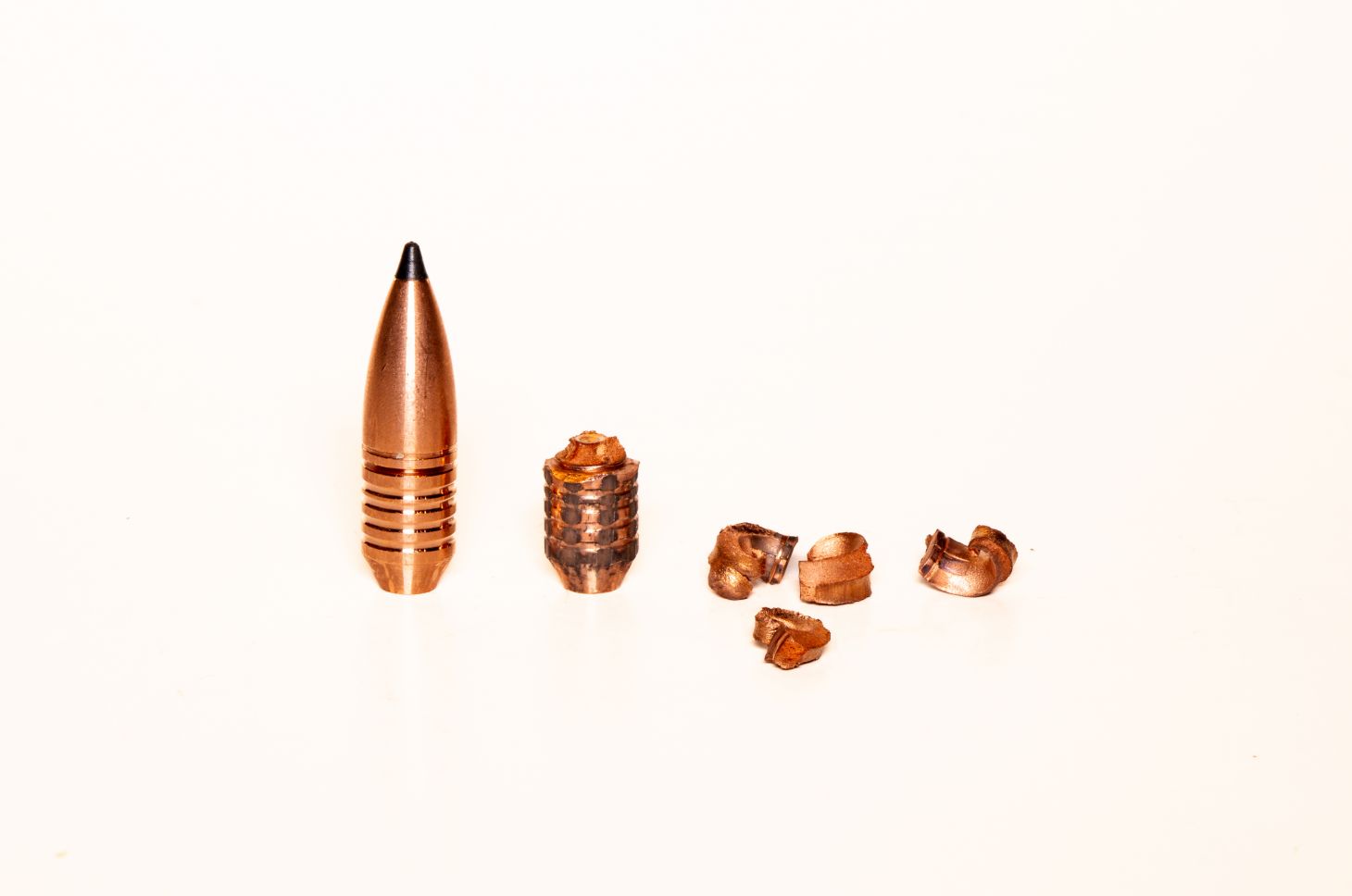
A hybrid bullet from Lehigh Defense on a white background.
Hybrid bullets like the TCC from Lehigh Defense act a bit differently than conventional bullets but generally deliver a balanced performance. (Photo/Richard Mann)

Then there are hybrid bullets—usually mono-metal bullets—designed to shed petals or create shrapnel right after impact. These are unique because they tend to damage a lot of tissue and penetrate well, without retaining a lot of weight or energy. Much like with conventional mono-metal bullets, the higher the impact velocity, the more work these bullets do, because they have more energy to work with. Remember, you square velocity when calculating kinetic energy.

What You Need to Know About Splash
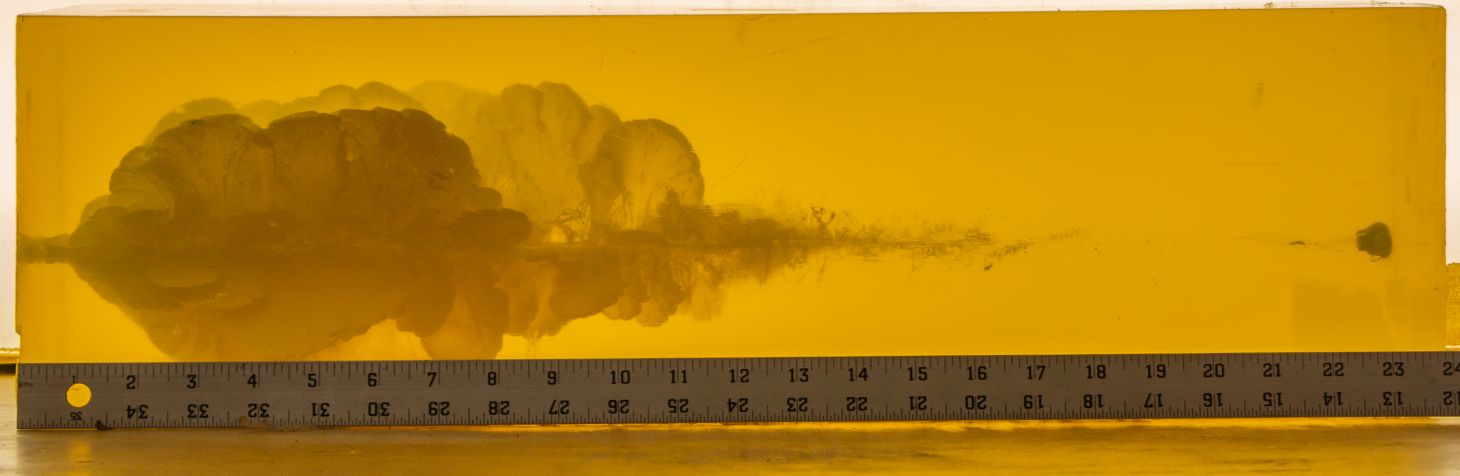
A bullet shot into ballistics gel.
This block of 10% ordnance gelatin clearly shows the splash the bullet makes as it deforms immediately after impact.

Now we come to the least-understood aspect of how bullets work, and it’s what I call the “splash.” Animals are made of blood engorged tissue, or as some like to say, 70% water. Like water, blood is uncompressible, so when a bullet impacts these tissues at high velocity, the tissues displace. This displacement, if violent enough, can damage the tissues/organs inside the animal. With little animals like prairie dogs, there’s not enough animal to contain the splash, which is why they sometimes explode. Big-game animals usually contain the bullet’s splash or tissue displacement.

To get an idea of how bullet size and velocity contribute to the intensity of this splash, drop a golf ball in a pond and observe the water’s dispersion. Now, throw the ball and notice how the splash increases. You can control the splash by how hard you throw the golf ball or by using a larger ball. Since a bullet changes shape soon after impact, its increased frontal diameter and velocity dictate the intensity of the splash or internal destruction. The more the velocity or the larger the bullet’s upset diameter, the more tissue it’ll damage.

But there’s an unseen thing that happens with lead-core bullets and those hybrid bullets that shed material during deformation. These miniature lead or larger metal pieces that separate from the bullet increase the intensity of the splash, because they have their own velocity and energy. This is why traditional lead-core bullets tend to outpace balanced bullets in tissue damage. They may not penetrate as deep, but they damage more tissue, especially on broadside shots.

So, Which Big-Game Bullet is Best?
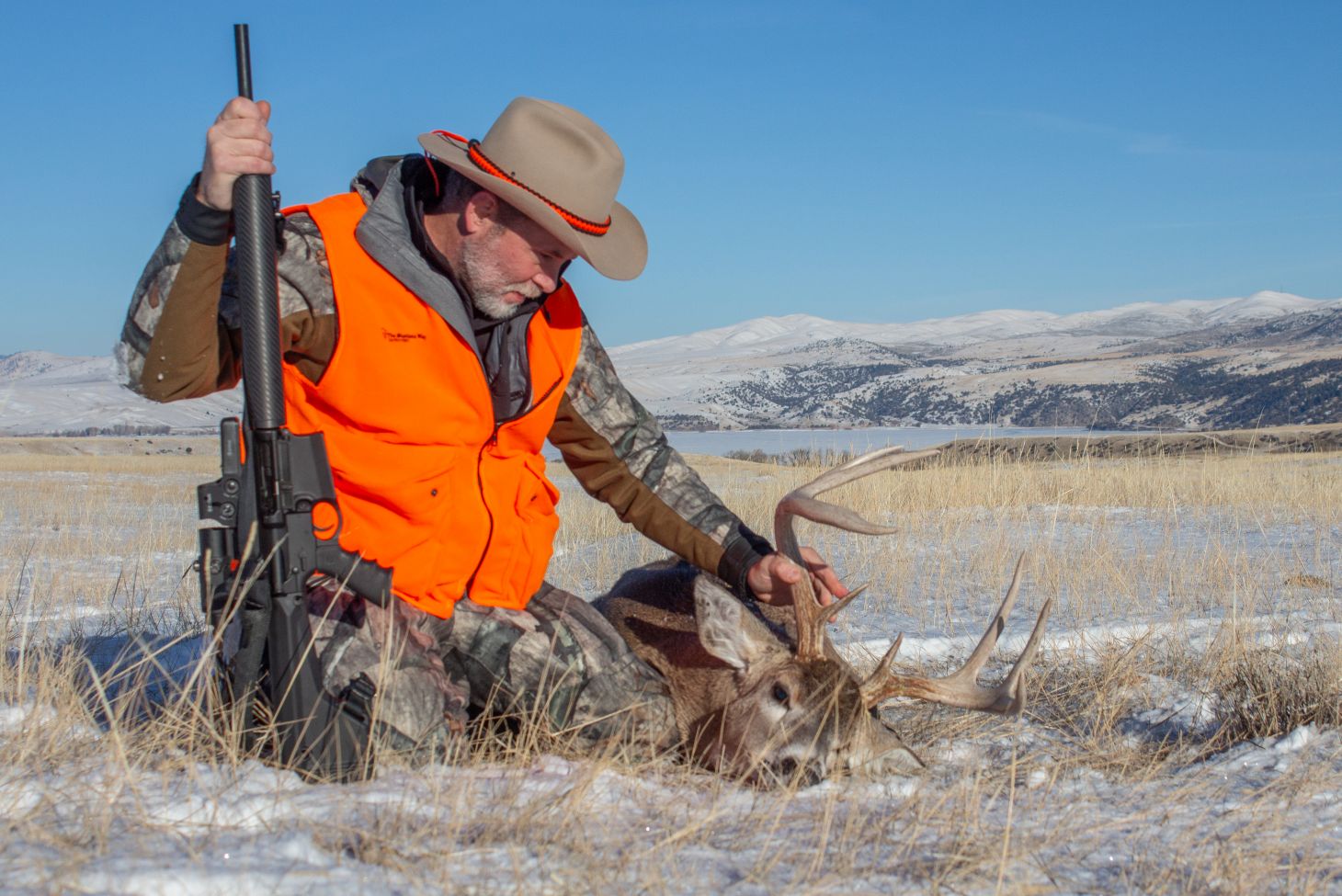
A hunter kneels next to a whitetail buck in a field.
Most modern big game bullets work very well. It’s up to you to decide the type of work you want them to do. (Photo/Richard Mann)

The larger the splash, the more cavitation and damage you have. Bullets that penetrate the deepest deliver the least amount of splash. You cannot have the best of both worlds, but you can get close, which is why bullets in the balanced category are so popular. They don’t damage voluminous amounts of tissue or always exit, but they provide a practical balance of performance. However, that does not mean they’re always the best choice.

Cavitating bullets can work great on deer-size game because you rarely need extreme penetration. They can even work well with larger game, too, if you don’t take extreme quartering shots. Of course, all bullets can become penetrators if impacting slow enough, but you really only need them for dangerous game. In the end, no one bullet is best for every situation. Instead, you need to apply what you know about how big-game bullets work, and pick the right bullet for the job at hand.

content_rifle-ammo,content_ammo,content_guns,content_outdoor-gear
Field & Stream 1871 Club

THE 1871 CLUB

The best outdoor stories the way they were meant to be read: in print. 160+ pages. Coffee table-quality. 2 issues per year.

Club Magazines and Hat
JOIN THE CLUB

Recommended Products

Richard Mann

    Richard Mann was born and raised in West Virginia and has hunted from the Montana mountains to the green hills of Africa. In 2015, Mann began contributing to Field & Stream to cover guns, ammunition, ballistics, and hunting. In 2022, he was named as the brand’s Shooting Editor. Highlights Education Mann has a degree in criminal justice and is a graduate of the West Virginia State Police Academy and the Southwest Law Enforcement Academy of Virginia. He is also graduate of the NRA’s Tactical Law Enforcement Firearms Instructor School as well as multiple courses at Gunsite Academy. As a high school senior, Mann was failing English and his teacher told him, “Choose another career path, because you’ll never write for Field & Stream.” Experience Because his mother was a hunter, Mann was hunting before he was born. He has traversed the world in pursuit of small, large, and dangerous game. He was a member of the 1995 West Virginia Police Pistol Governor’s Twenty, won the 1999 WV National Guard State Pistol Match, and the 2004 WV Muzzleloader Metallic State Championship. Mann established a Scout Rifle training course for Steyr and assisted Gunsite Academy with the development of their Laser Integrated 250 Pistol Course. Mann has worked with many bullet manufacturers conducting ballistic experiments and has a patent for a bullet testing media and a scope reticle. He’s contributed to many periodicals, presented reloading seminars for the NRA, appeared on the Discovery Channel as a firearms expert, and was the executive producer of WildCraft: South Africa, on Amazon Prime. In 2019, Mann was awarded the Bill McRea Lifetime Achievement Award for his writings. F&S Lightning Round Favorite Place to Hunt: Family hunting camp in West Virginia,Favorite Critter to Hunt: Whitetail deer,Bucket List Adventure: Lion hunt with PH Geoffrey Wayland and my son,Most Prized Piece of Gear: New Ultra Light Arms Model 20S in .30 Remington AR,All-Time Favorite F&S Story: “Ghosts of Africa” by David E. Petzal Notable Work

    Related Posts

    Federal’s new 6.5 Creedmoor +PEAK standing on a scope turret.

    Ammo Review: Federal’s New 6.5 Creedmoor +PEAK Is the Next Step in a Rifle Cartridge Revolution

    June 5, 2026
    Rifle cartridges on a wood surface with dark background.

    The So-Called “Killing Power” of Your Favorite Rifle Cartridge Is Total B.S.

    May 22, 2026

    The 5 Fastest Rifle Cartridges

    May 1, 2026

    The 6 Best Big-Game Loads for the .308 Winchester

    April 29, 2026
    Leave A Reply Cancel Reply

    1871 CLUB
    Field & Stream 1871 Club

    JOIN THE CLUB

    Spoil your dad with a gift of a Field & Stream Membership, then go the extra mile with our exclusive Father's Day add ons.

    Father's Day Gifts
    JOIN THE CLUB TODAY

    NEWSLETTERS

    NEWSLETTERS

    Weekly recaps of the latest outdoor news, hunting and fishing tips - plus exclusive offers, giveaways and more!

    Field & Stream Newsletter Whitetail 365 The Strike Zone The Strike Zone
    SIGN UP
    F&S PICKS
    An ATV rider on public lands in the West. Public Lands & Waters

    Trump Orders More Off-Road Vehicle Use on America’s Public Lands

    Federal’s new 6.5 Creedmoor +PEAK standing on a scope turret. Rifle Ammo

    Ammo Review: Federal’s New 6.5 Creedmoor +PEAK Is the Next Step in a Rifle Cartridge Revolution

    Knives

    The Best Early Prime Day Knife Deals—Starting at Just $11

    Weekly recaps of the latest outdoor news, hunting and fishing tips - plus exclusive offers, giveaways and more!

    SIGN UP
    Instagram Facebook-f X-twitter Tiktok Youtube
    Shopping
    • Military & First Responders Discount
    • Shipping
    • Returns
    Company
    • About Us
    • FAQs
    • Contact Us
    Legal
    • Affiliate Disclosure
    • Privacy Policy
    • Terms of Service
    • F&S Music Fest Refund Info
    • Privacy and cookie settings
    Partners
    • Nashville Race Weekend Sweepstakes
    • Amazon
    • Best Home Furnishings
    • F&S x Gokey Collection
    • Moultrie
    • Old Wood Signs
    • Sugarlands Distilling Co.
    • Tractor Supply Co.
    • Yuengling
    • WearSPF
    • Whiskey JYPSI
    • Field & Stream Lodge Co.
    Disclaimers

    Articles may contain affiliate links that enable us to share in the revenue of any purchases made.
    Registration on or use of this site constitutes acceptance of our Terms of Service.

    © 2026 Field & Stream All rights reserved.

    • Sitemap

    Type above and press Enter to search. Press Esc to cancel.