We may earn revenue from the products available on this page and participate in affiliate programs. Learn more
Every shot at a turkey is a unique and random event. You throw hundreds of pellets downrange, hoping a few find the head and neck. It’s a target, as one custom choke maker once described it to me, “the size of a walnut balanced on a pencil.” Hitting that target seems like a haphazard proposition, but it’s highly repeatable if you choose the right shotgun, choke, and load.
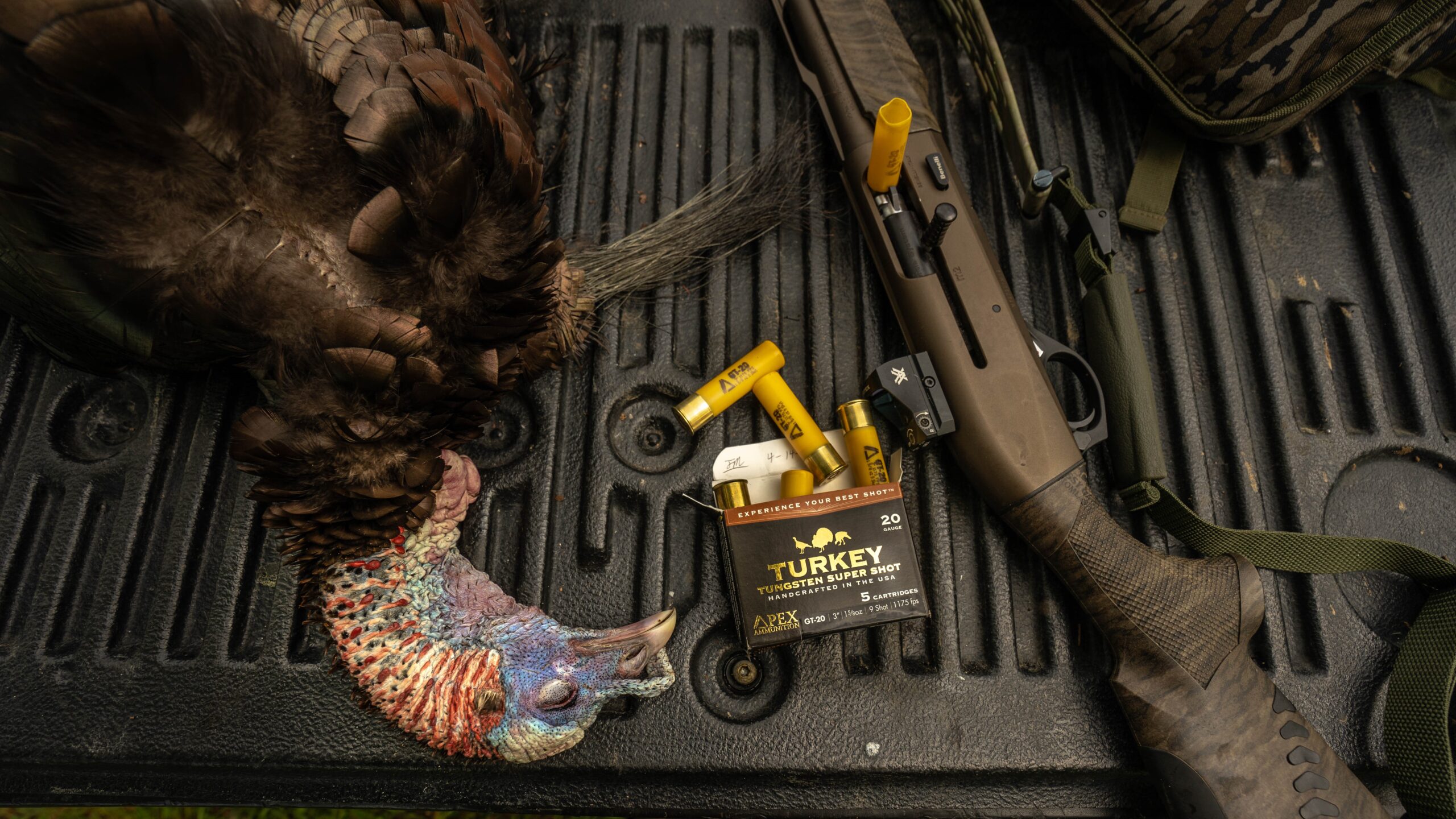
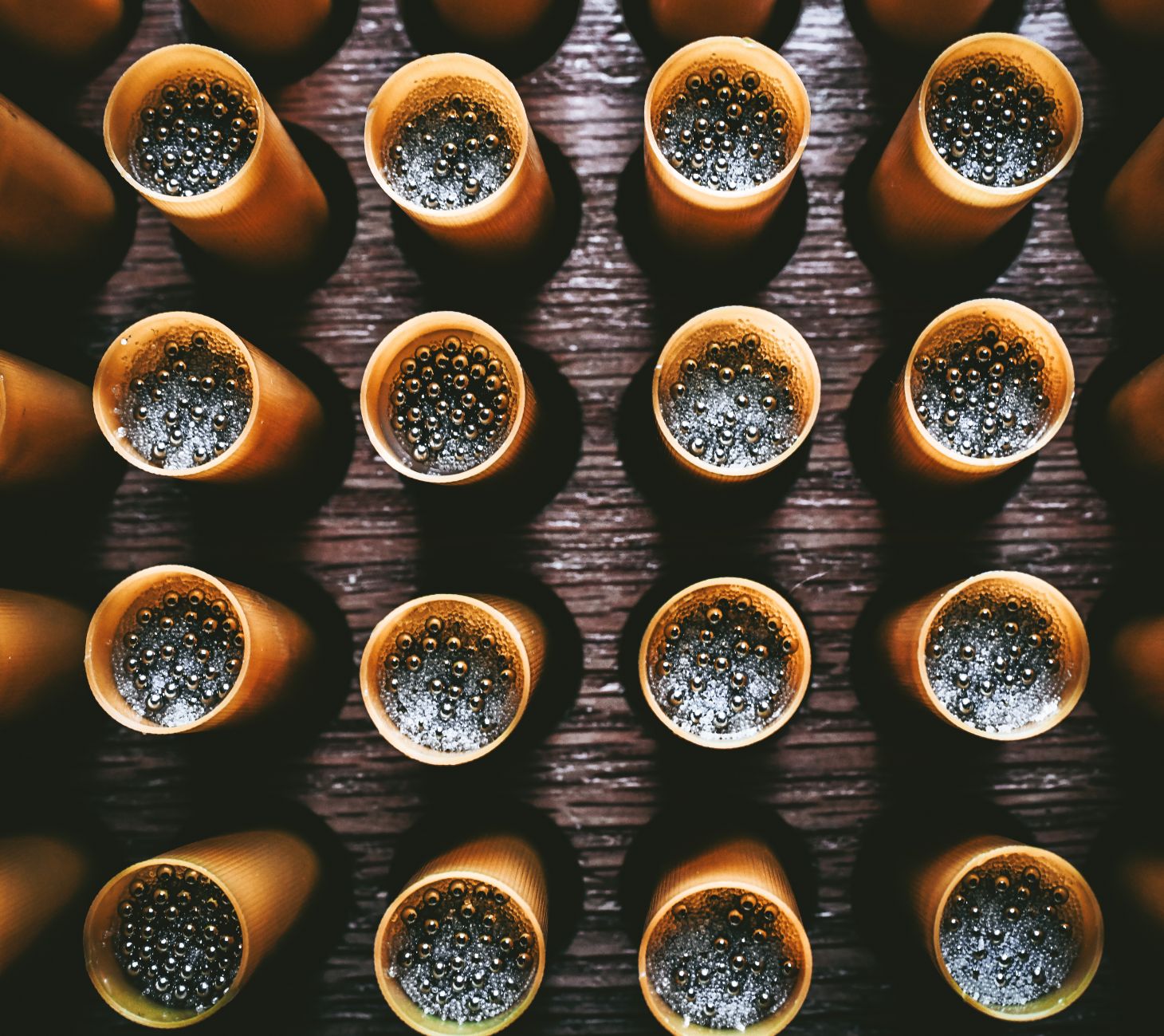
As turkey hunters, we live in a strange and wonderful time. Tungsten Super Shot (TSS) shoots patterns—even from smallbores—that we never could have imagined possible a few years ago. The extreme density of TSS means that shot as small as 9 and 10 are adequate for turkeys, and TSS payloads contain much more shot than lead shells ever could. More shot, especially if it’s uniform, round, and dense as TSS is, results in patterns that produce double or triple what it takes to kill a turkey at normal ranges. TSS also permits longer ethical shots than were ever possible before.
But there’s a problem: TSS isn’t cheap, and it has just doubled in price, thanks to retaliatory tariffs placed by the United States government against China, where TSS comes from. While hunters were ponying up $10 per shell for premium performance, now TSS costs over $20 per shell in some configurations. This spring we’ll find out how much we’re willing to pay. There are still solid lead options on the market, too, for those that don’t want or need to spend so much on ammo. Also, while 18 grams per cubic centimeter TSS is subject to tariffs, 17 g/cc tungsten is not, and some ammo makers are beginning to load those pellets instead. I pattern-tested several new loads, as well as some old stand-bys, to help you pick your turkey poison for 2026.
- Best Pattern: Apex Turkey
- Best Lead Load: Winchester Long Beard XR
- Boss Tom
- Winchester Long Beard TSS
- Winchester Long Beard Tungsten
- Remington Nitro Turkey
- Apex Mossy Oak Greenleaf Turkey
- Migra Hybrid
- Migra TSS
- Federal Rob Roberts Limited Edition TSS
- Federal Grand Slam Realtree 40th Anniversary
Best Pattern: Apex Turkey
best pattern
Apex Turkey
Specs
- Gauges: 3 ½-inch 10-gauge, 3 ½-, 3-inch, and 2 ¾-inch 12-gauge, 3-inch and 2 ¾-inch 20-gauge
- Material: TSS
- Payloads: 2 ½-ounces (10- and 3 ½-inch 12-gauge) and 2 ¼ and 2 ounces (3-inch 12) 1 5/8 ounces (3-inch 20-gauge), 1 ½ ounces (2 ¾-inch 20-gauge)
- Velocity: 1100 to 1200 fps
- Shot sizes: 7 1/2, 8, 9
- Load tested: 3-inch 12-gauge 2 ¼-ounce 9 shot
- Price: $69-$114 per 5
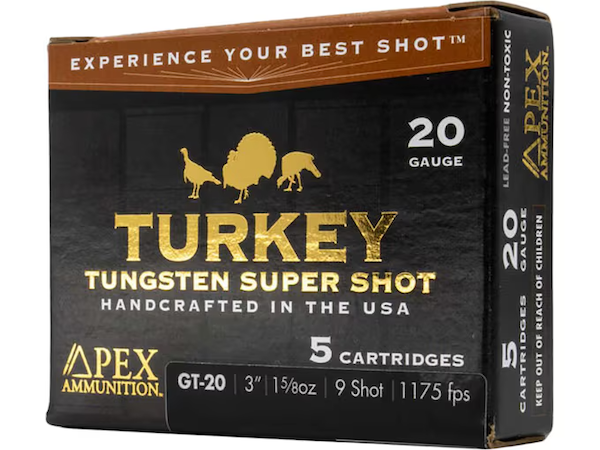
Apex was the first company to factory-load TSS, beating Federal by a nose. “Factory” is a slight misnomer, since every TSS turkey shell produced at the Apex plant is hand-loaded. The red-hulled 12-gauge shells have roll crimp with a white over-shot card on top. Inside, there are lots of small, very round, shiny pellets packed in ample amounts of plastic buffer. There’s also a thick felt filler wad at the bottom of the shotcup.
In my 870, these shells averaged 287 hits in the 10-inch circle at 40 yards. That is a lot of holes, bringing to mind the quote, “quantity has a quality all its own.” My results in the field with these loads last spring proved that statement correct. I shot one bird with 12-gauge 9s at 40 yards in Indiana and one closer to 50 yards in Iowa. If you want to send the most pellets downrange, a 12-gauge Apex Turkey load is a great choice.
Best Lead Load: Winchester Long Beard XR
best lead load
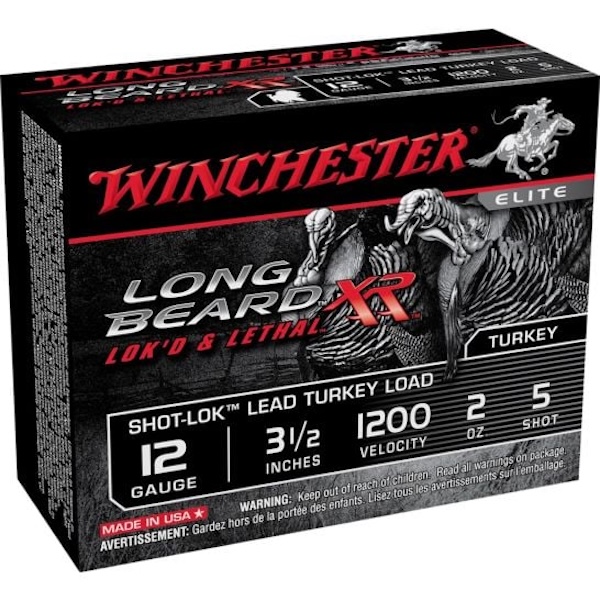
Winchester Long Beard XR
Specs
- Gauges: 3 ½-, 3-inch, and 2 ¾-inch 12-gauge, 3-inch 20-gauge
- Material: Lead
- Payloads: 2 1/8 and 2 ounces (3 ½-inch 12), 1 7/8 and 1 ¾ ounces (3-inch 12), 1 ¼ ounces (2 ¾-inch 12), 1 ¼ ounces (20-gauge)
- Velocity: 1000 fps 20-gauge, 1200 to 1300 fps 12-gauge
- Shot sizes: 4, 5, 6 shot (20-gauge in 5 and 6 only)
- Load tested: 3-inch 12-gauge 5 shot high velocity (1 3/4-ounce payload), also one shot high velocity 12-gauge 6 shot
- Price: $35.99-$42.99
Winchester Long Beard is unique among turkey loads. There’s an extra step in the loading process: after the shot drops into the shotcup, molten resin is poured onto it. The resin then hardens into a solid casing, which shatters upon ignition. That casing turns into shards of cushioning buffer that protect the lead shot and keep it round as the shot accelerates from 0 to 1200 fps in an instant. Buffer keeps the pellets round, and round pellets fly true. Long Beard adds yards to lead’s effective range while remaining much more affordable than high-dollar tungsten-iron.
At 40 yards, Long Beard delivered a sure-killing 108 hits on target with 5 shot. Because I found a random load of 6s that had somehow made it into my range bag, I shot it as a bonus. It recorded 168 hits in the 10-inch circle. Either load would flatten a turkey at 40 or a few yards more. Long Beard comes in both magnum (heavier payload) and high velocity. Although increasing velocity should open patterns, I’ve found the HV to be great loads.
Boss Tom
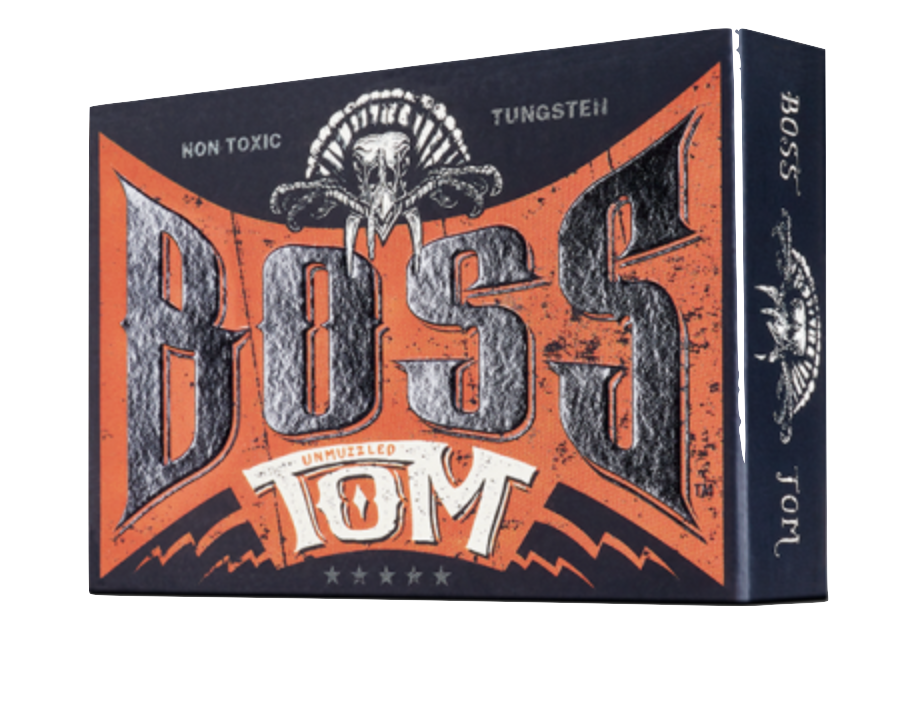
Boss Tom
Specs
- Gauges: 3-inch 12- and 3-inch 20-gauge, 2 ¾-inch 28-gauge
- Material: TSS
- Payloads: 2 ½ ounces (12-gauge), 2 1/16 ounces (20-gauge), 1 ¼ ounces (28-gauge)
- Velocity: 1050 fps
- Shot sizes: 7 and 9
- Load tested: 20-gauge 7 shot
- Price: $60/5 (20-gauge)
Boss offers heavier payloads than anyone else in their Boss Tom TSS line. The 3-inch 20-gauge shells I tried hold over 2 ounces of shot—2 1/16 ounces to be exact—which is nuts. The hull has a folded crimp and nicely stamped printing on the side. The uniform, copper-plated shot is pretty, too. It’s also buffered, and both the buffer and the plating help the shot flow smoothly through the choke.
Although a friend’s gun shot impressive patterns with this load in 9 shot, my results with the factory Winchester choke were very good, but not great. Still, they averaged 110 hits in a 10-inch circle at 40 yards. Given that TSS 7 shot should be superior to lead 4s in penetration, that’s a lot of punch from a 20-gauge and a dead bird ten times out of ten as long as I don’t stretch too much beyond 40.
Winchester Long Beard TSS
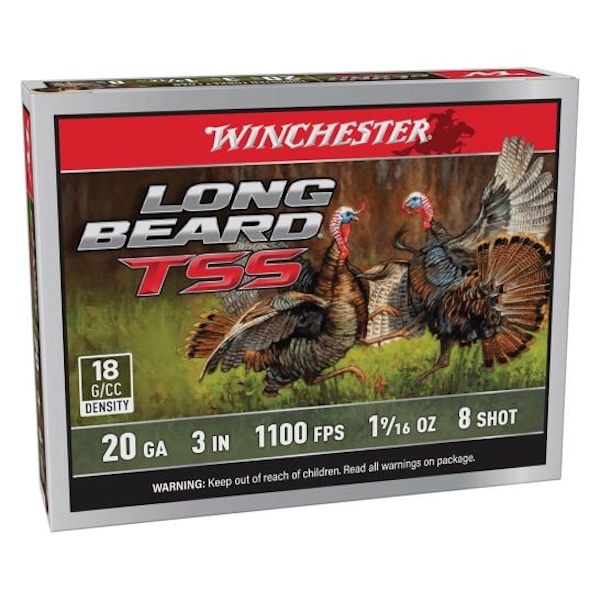
Winchester Long Beard TSS
Specs
- Gauges: 3 ½- and 3-inch 12-gauge, 3-inch 20-gauge, 3- and 2 ¾-inch 28-gauge, 3-inch .410
- Material: TSS
- Payloads: 2 ¾ ounces (3 ½-inch 12), 2 3/8 ounces (3-inch 12-gauge), 1 9/16 ounces (20-gauge), 1 ½ ounces (3-inch 28), 1 ¼ ounces (2 ¾-inch 28), 9/16 (3-inch .410)
- Velocity: 1050-1100 fps
- Shot sizes: 8 or 9 in 12- and 20-gauge, 9 in 28 and .410
- Load tested: 3-inch 12-gauge 8 shot
- Price: $60-$100 per 5
Winchester responded to customer demand for a TSS turkey load by coming out with a full line of Long Beard TSS in 2025. Available in all gauges (including 3-inch 28) except for the 16, Winchester Long Beard TSS has a shell for any turkey gun. These new loads are buffered, although not with the epoxy buffer of the lead Long Beard, because TSS pellets are too hard to deform. Instead, the buffer helps the heavy payloads flow smoothly through a tight choke tube.
Winchester offers the 12- and 20-gauge shells in either 9 shot, which is common in TSS loadings, or 8 shot. Eights are a nice compromise, as the pellet counts of 9 shot veer deeply into oversaturation and overkill territory, while 7 shot gives you a ton of penetration energy (perhaps more than you need) but sacrifices pellet count. There are 254 pellets in an ounce of TSS 8 shot, so the 2 3/8-ounce 12-gauge load contains 600 pellets, each with almost the penetration energy of lead 2 shot. Long Beard shot one “bad” pattern of 146 hits in the 10-inch circle, and even that is more than enough. Overall, it averaged 198 hits, which is very good performance, especially because these size 8 pellets retain monster energy.
Winchester Long Beard Tungsten
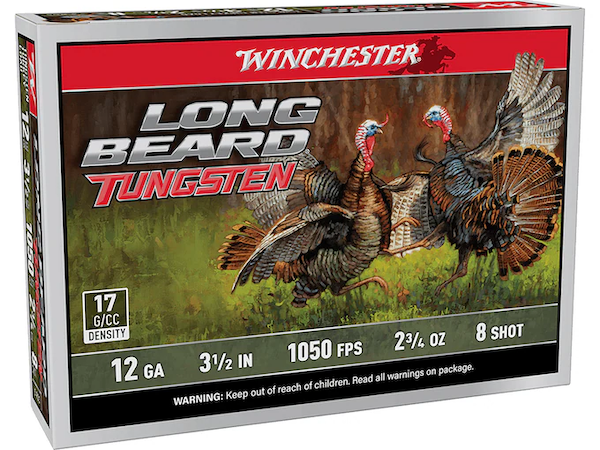
Winchester Long Beard Tungsten
Specs
- Gauges: 3 ½- and 3-inch 12-gauge, 3-inch 20-gauge, 3- and 2 ¾-inch 28-gauge, 3-inch .410
- Material: Tungsten-iron
- Payloads: 2 ¾ ounces (3 ½-inch 12), 2 ¼ ounces (3-inch 12-gauge), 1 9/16 ounces (20-gauge), 1 ½ ounces (3-inch 28), 1 ¼ ounces (2 ¾-inch 28), 13/16 (3-inch .410)
- Velocity: 1050-1100 fps
- Shot sizes: 8 or 9 in 12- and 20-gauge, 9 in 28, and .410
- Load tested: 3-inch 12-gauge 8
While you may see some Winchester Long Beard TSS still on dealer’s shelves this spring, Winchester isn’t loading any more because tariffs and wartime demand are making TSS expensive and hard to come by. Long Beard Tungsten is replacing it. The pellets in Long Beard Tungsten have a density of 17 grams per cubic centimeter, making them slightly less dense than TSS at 18 g/cc. For some reason, this exempts them from tariffs on China, so they sell for slightly less than true TSS. From what I saw at the range, Long Beard Tungsten shoots every bit as well as the TSS loads did.
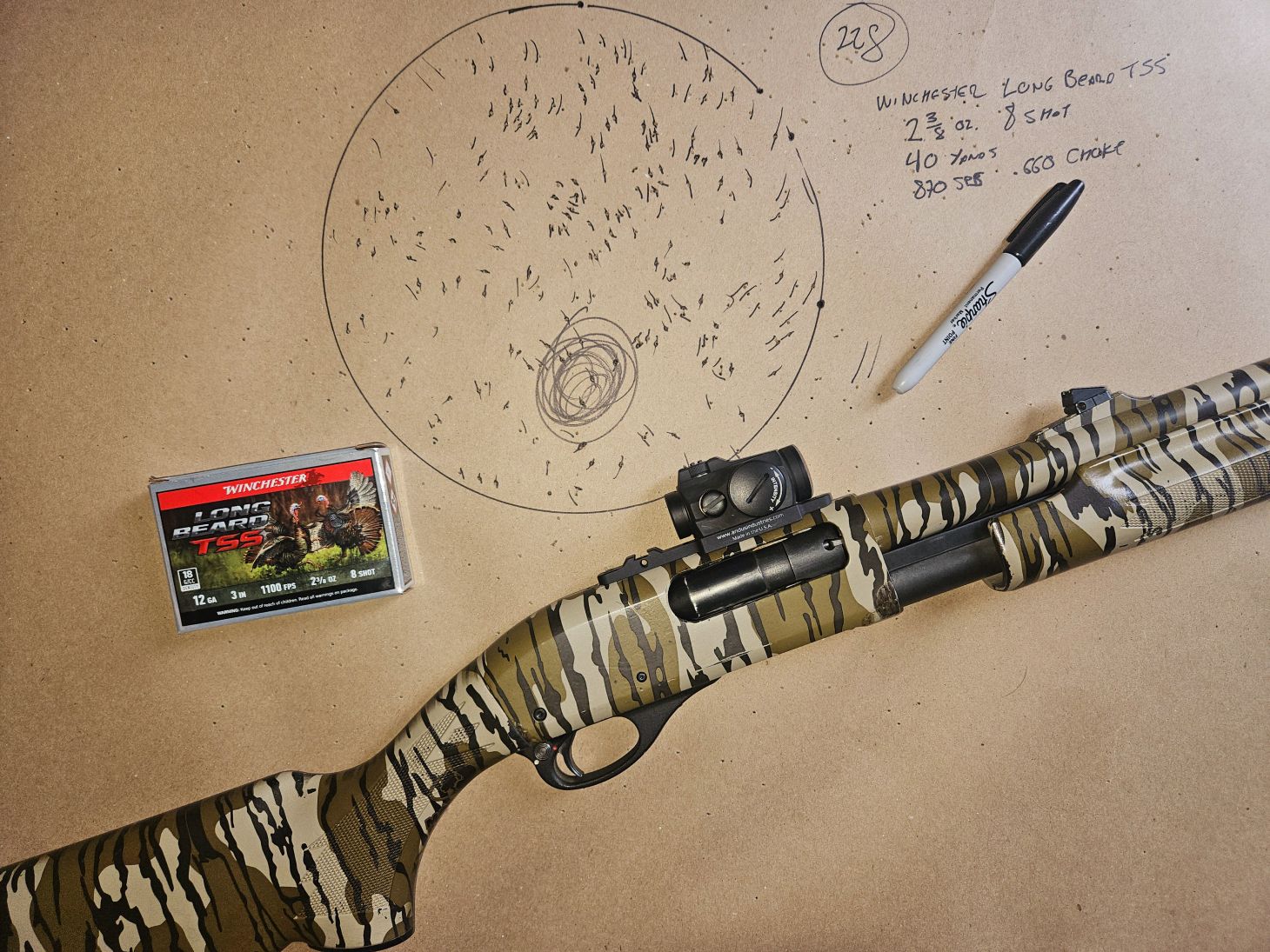
I tested the 3-inch, 12-gauge 8s, and I shot them alongside some Long Beard TSS 8s I had left over from last year, both out of an 870 Super Magnum with a .660 Rob Roberts choke. Results were nearly identical, with TSS averaging 280 hits in the 10-inch circle at 40 yards, and Long Beard Tungsten doing 271. Incidentally, my results with TSS were much better, from the same lot of shells, than they were a year ago. It just goes to show that every day is different, and temperature and humidity can greatly affect patterns. But I digress. After shooting the 40-yard test, I took a few random shots, which resulted in 171 hits in a 10-inch circle at 50 yards with the 870; 303 at 40 from a Mossberg 835 and a Jeb’s .660 choke; 262 from a Mossberg 500 with an Indian Creek .562 on board.
The Tungsten patterns beautifully. The pellets are round and buffered, just as they were in Long Beard TSS. You get a few more pellets in an once of Long Beard Tungsten than you did with TSS. There are 278 Tungsten 8s per ounce, compared to 254 TSS 8s. In 9 shot, the difference is 362 TSS versus 407 Tungsten. However, because it is not quite as dense as the original TSS, you will likely see a drop-off in energy and pattern efficiency at very long ranges. If you want to shoot turkeys at long range, 8s are a better choice than 9s, just as they were with 18 g/cc TSS. If you keep your shots to 50 and closer, you will never notice any difference.
Remington Nitro Turkey
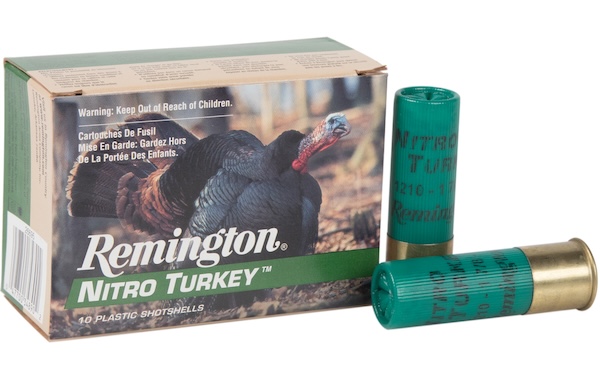
Remington Nitro Turkey
Specs
- Gauges: 3 ½-, 3-inch, and 2 ¾-inch 12-gauge, 3-inch 20-gauge
- Material: Lead
- Payloads: 2 ounces (3 ½-inch 12), 1 7/8 ounces (3-inch 12), 1 ½ ounces (2 ¾-inch 12), 1 ¼ ounces (20-gauge)
- Velocity: 1185 (20-gauge) to 1300 fps
- Shot sizes: 4, 5, 6 shot (20-gauge in 5 only)
- Load tested: 3-inch 12-gauge 5 shot
- Price: $14.99-22.99
I will always be fond of these shells because I shot my first turkey with a 2 ¾-inch Remington Nitro Mag load of 5 shot out of my Browning Double Automatic with a fixed Modified choke. The bird was 35 yards away and fell just as dead as it would have had I hit it with a swarm of TSS 9s. That was a long time ago, but there is still a place for lead in the turkey woods, and it has a huge cost advantage over TSS. You can almost buy ten of these for the price of one TSS shell. Still, turkey hunting is a one-shot game, so your one cheap shell has to deliver. Shooting these loads and counting holes was like a lesson in turkey-hunting history. They averaged 55 hits in a 10-inch circle at 40 yards. By the standards of the ’80s and early ’90s, we’d have called that a near-40-yard load.
I did have problems with the hulls sticking to the chamber of my gun, which can happen when rough chambers and inexpensively made hulls meet. These may work fine in your gun, and if you want to save money and shoot your turkeys at 35 yards or less (which is a win-win, frankly, because shooting turkeys close is way more fun than shooting them far away), these shells might be your answer.
Apex Mossy Oak Greenleaf Turkey
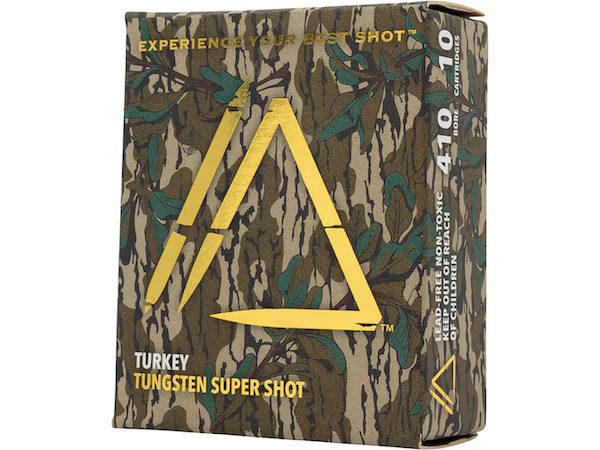
Apex Mossy Oak Greenleaf Turkey
Specs
- Gauges: 3-inch 12, 3-inch 20, 2 ¾-inch 28, 3-inch .410
- Material: TSS
- Payloads: 3-inch 12 Gauge (2-1/4oz) and 20 Gauge (1-5/8oz), 28 Gauge 2 3/4″³ (1-1/2oz), .410 (7/8 ounce)
- Velocity: 1060 fps
- Shot sizes: 9/10 blend
- Load tested: .410
- Price: $84.99/10 in .410
Packed in a 10-round Mossy Oak Greenleaf camo box with the gold Apex logo on top, these shells impress before you ever get a look at the black hulls inside. Like the larger Apex Turkey load, they have a roll crimp and a round overshot wad. There’s a skinny .410 shotcup inside with a layer of tiny TSS 10 shot on top of some 9s resting on a foam cushion wad. The total pellet count between the 9s and 10s is 362 pellets.
In a Mossberg 500 turkey gun with a factory choke, the Apex Greenleafs averaged 118 hits in a 10-inch circle at 40 yards. That’s enough hits to make this a 40-yard turkey gun. Beyond that distance, the smaller 10-shot may begin to run low on penetration energy. I did have a problem with these sticking in the chambers of the 500. As I mentioned earlier, it takes both the wrong shell and the wrong gun for this problem to occur. I fired a couple through my H&R single shot. I was confident a break-action would eject the hulls, and it did.
Migra Hybrid
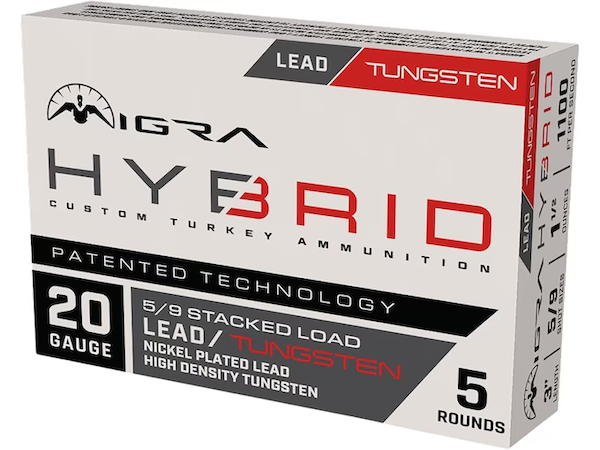
Migra Hybrid
Specs
- Gauge: 3-inch 12- and 20-gauge
- Payload: 2 ounces in 12-gauge, 1 ½ ounce in 20-gauge
- Velocity: 1100 fps
- Shot sizes: 5 lead/9 tungsten 50/50 mix
- Load tested: 20-gauge 5 lead/9 tungsten
- Price: $38.99/5
The rising price of TSS creates demand for tungsten performance without the price. Migra Hybrids combines 17 g/cc tungsten 9 shot (which is not subject to TSS tariffs) with lead 5s. Since Migra is already known for its excellent stacked-steel waterfowl loads, the Hybrid turkey loads fit right into its lineup. The 9 tungsten and 5 lead pellets are roughly equivalent in terms of penetration, and the 9 shot increases pellet count, while the lead 5s keep the overall cost down. The 20-gauge loads contain 200 tungsten pellets and 141 lead pellets.
The shells are white, with a sealed 6-point crimp to keep moisture out, and a cardboard overshot wad beneath it to keep tiny 9 pellets from leaking out. The lead 5-shot portion of the payload consists of bright, nickel-plated shot, and it is stacked on top of an equal weight of tungsten-iron 9s. The payload is buffered and encased in a one-piece shotcup. In my Model 500 with an Indian Creek .562 choke, these shells averaged 144 hits in a 10-inch circle at 40-yards. As you might expect, given their greater number and superior ballistics, the tungsten 9-shot predominate the 10-circle, while the 5s—identifiable by the larger holes they made in the paper—fill in some gaps. One hundred forty-four hits is a sure thing at 40 yards, and further pattern testing might prove it to be good at 45 or 50. I would hunt with these.
Migra TSS
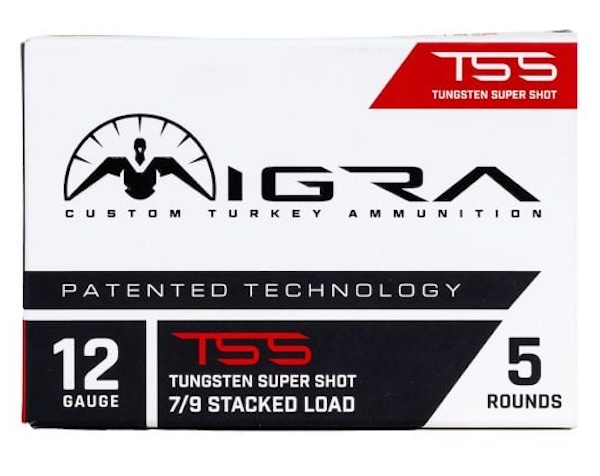
Migra TSS
Specs
- Gauges: 3-inch 12, 3-inch 20, 3-inch .410
- Material: TSS
- Payloads: 2 ounces (3-inch 12-gauge), 1 5/8 ounces (3-inch 20-gauge), 7/8-ounce (3-inch /.410)
- Velocity: 1100 fps
- Shot sizes: 7/9 blend, 9
- Load tested: 20-gauge 7/9 blend
- Price: $70 per 5 20-gauge
Migra, the boutique shell-maker from South Carolina, built a reputation among duck hunters for its stacked TSS/steel loads. For turkeys, Migra goes all-TSS, offering both straight 9s and 7/9 stacked loads in 12- and 20-gauge and .410. They come in a bulky but handsome box, and the shells themselves look great. I appreciated the shot size stamped on the steel cartridge head, where it will last longer. Most turkey shells are loaded and unloaded many times before they are ever shot, so it’s nice to have durable printing that won’t wear off, leaving you to wonder what’s inside the hull.
The shell is closed with nice 8-point crimp, rarely seen outside of target loads. That crimp, plus the overshot card underneath it, assures that moisture (within reason, these aren’t duck shells) stays out and the fine-grained buffer stays in. The stacked loads combine 40 percent 7 shot on top of 60 percent 9 shot for a total of 444 pellets in my 20-gauge test shells. At 40 yards, they averaged 134 hits in the 10-inch circle, which is good and could probably be better if you tried different chokes. It’s more than enough that I’d be confident in shooting at 45-yard-plus turkeys with these shells.
Federal Rob Roberts Limited Edition TSS
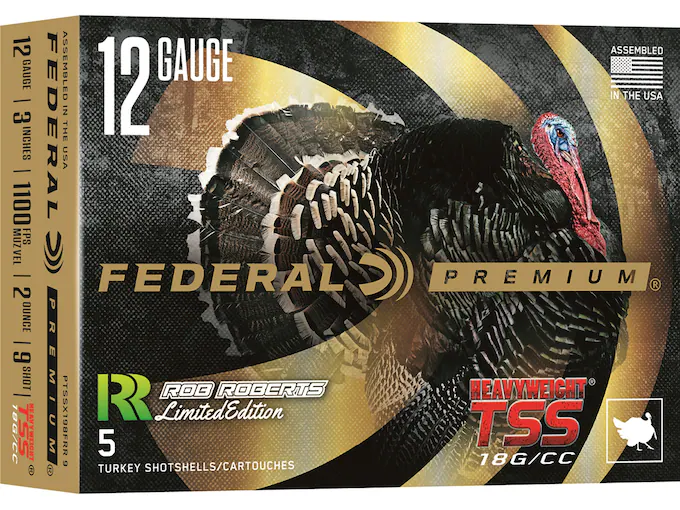
Federal Rob Roberts Limited Edition TSS
Specs
- Gauges: 3-inch 12- and 3-inch 20-gauge
- Material: TSS
- Payloads: 2 ounces (12-gauge), 1 5/8 ounces (20-gauge)
- Velocity: 1100 fps
- Shot sizes: 7 and 9
- Load tested: 12-gauge 9
- Price: $111.99/5 (12-gauge) $97.99 (20-gauge)
Choke master Rob Roberts worked with Federal to develop these premium shells. They are loaded into eye-catching, bright green hulls and roll-crimped with a black over-shot disk bearing Federal’s logo. For what you’re paying, these shells should be good-looking, and they are. They should also perform. Two ounces of TSS shot sit inside Federal’s tight-patterning Flitecontrol flex wad, cushioned by ground buffer material to help it flow through tight turkey chokes. The muzzle velocity is 1100 fps in the 12-gauge, while the 20 has a 1 5/8-ounce payload at 1000 fps.
In my 870 the 12-gauge loads shot excellent patterns at 40 yards, averaging 262 pellets in a 10-inch circle at 40 yards. I tried one in my 835 with Jeb’s .660 and broke the 300-pellet mark with 308. While sighting-in a 20-gauge Mossberg 500 with an Indian Creek choke I tried one 20-gauge RR Limited Edition out of curiosity, and it put 282 pellets in the circle. So yes, these shoot.
Federal Grand Slam Realtree 40th Anniversary
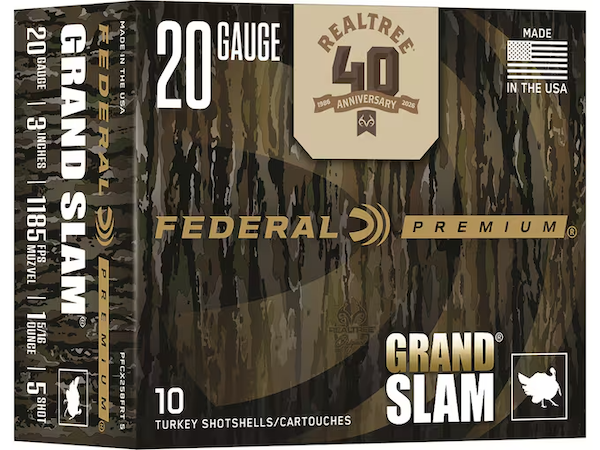
Federal Grand Slam Realtree 40th Anniversary
Specs
- Gauges: 3-inch 12- and 3-inch 20-gauge and 3-inch .410
- Material: Lead (12- and 20-gauge only) and TSS 13/16 9 TSS .410
- Payloads: 2 ounces lead, 1 ¾-ounces TSS (12-gauge) 1 5/8 ounces lead, 1 1/2-ounces TSS (20-gauge), 13/16-ounce TSS (.410)
- Velocity: 1200 fps (12-gauge lead and TSS) 1185fps (20 gauge lead) 1100 fps 20- and .410.
- Shot sizes: 9 TSS, 5 lead
- Load tested: 20-gauge 5 lead
- Price: 93.99/5 (12-gauge) $81.99/5(20-gauge) 27.99/10 (12-gauge lead) 23.99/10 (20-gauge lead) 61.99/5 .410
Federal’s 40thanniversary Realtree turkey loads consist of two lead and three Heavyweight TSS offerings. My lead test shells were loaded in 20-gauge and packaged appropriately in a 40th-anniversary box decorated with original Realtree camo. I was rooting for these because if you do the math they cost almost 1/10 of what the TSS versions sell for.
The shells themselves looked like the standard Federal Grand Slam, with uniformly round, hard, copper-plated pellets nestled in ground plastic buffer to help them keep their form during the stress of 0-1200 fps ignition. The Flitecontrol Flex wad works in ported and non-ported chokes alike. At 40 yards, these averaged 59 hits in the 10-inch circle from my 20-gauge Model 500. By pre-tungsten standards, this isn’t bad at all, and the Grand Slam Realtree 40thAnniversary rates as a 35-yard turkey load. I have seen plenty of 12-gauge lead loads that didn’t shoot this well.
How We Tested Turkey Loads
The first step was to examine the exterior of the shells, then dissect each shell, examine its components, and count the pellets to ensure the manufacturer’s specs were accurate. Pattern tests with each shell were conducted at 40 yards. I used the 10-inch circle to evaluate patterns, as that size is just right to encompass a turkey’s head and neck. And it has become the standard for turkey loads, replacing the traditional 30-inch circle used to evaluate patterns for wingshooting.
The results were tabulated and evaluated for effectiveness. Any failures to function (dead primers, etc) were noted, although this year, there were no ammo malfunctions. I used a 12-gauge 870 Super Mag with a Rob Roberts .660 choke, a 20-gauge Winchester SXP Long Beard with a factory choke, a 20-gauge Mossberg 500 with an Indian Creek .562 choke, and a .410 Mossberg 500 with a factory choke for my tests, fully aware that some loads prefer other guns and chokes. I occasionally shot random patterns with my Mossberg 835 12-gauge with a .660 Jeb’s choke as a sort of double-check. For Federal bismuth, I broke out my old 3-inch factory Full Model 12 as a representative of the type of gun that the ammo is made for. Your mileage might vary from my results, but these are all common guns in the turkey woods.
FAQs
Q: Are tungsten turkey loads worth it?
Tungsten shells are now ridiculously expensive. They also outperform lead by a wide margin. But are they really worth $20 or more per shell? If you want to ethically hunt with a .410 or 28-gauge without limiting yourself to shots inside 20-25 yards, you’ll need TSS or tungsten shot, which is slightly less dense and somewhat less expensive. The good news is that smallbore shells cost a little less because they contain less pricey shot. TSS or tungsten is also worth the money if you want to take shots beyond 50 yards with heavier 12-gauge or 20-gauge loads. If you get birds in close, which is the most fun way to hunt turkeys, then regular lead loads are all you need. We shot 40-yard turkeys with lead in the days before TSS, although 40 was extremely long range, and we can still do it today.
Q: What’s the best shot size for turkeys? 5 or 6?
In lead shot, both 5 and 6 are very popular among turkey hunters. Six-shot has the advantage of higher pellet counts per ounce (about 220 for 6s vs 170 for 5s), so most of the time, a load of 6 shot will put more pellets on target, and that’s important when that target is as small as a turkey’s head and neck. Five shot is bigger and heavier and retains more energy than 6s at longer ranges. For shots over 40 yards, that extra energy matters because you want pellets that will penetrate the bones of the skull and vertebrae. The answer is to pattern your gun and see how it performs with each shot size. You can evaluate patterns by how many hits your shell puts in a 10-inch circle at the range you hope to shoot a bird. Ideally, you’ll see around 100 pellet strikes in that circle with whatever shot you choose. In TSS or tungsten, 7s and 9s are the most popular, although some shells contain 8 shot, or a blend. Most hunters seem to prefer the higher pellet count of 9 shot.
Q: What choke is best for turkey loads?
Most turkey hunters choose very tight extended choke tubes for turkey hunting, with constrictions much greater than you find in a standard full choke. Such chokes produce the “hot center,” packing many hits into the pattern core for head and neck strikes. In 12-gauge, .660 and .665 chokes are popular. Before you buy a special choke, try the standard Full choke that came with your gun. It should be fine for shots inside 35 yards and be a little easier to hit with, as the pattern will be slightly bigger than it will with a turkey choke at closer ranges. Also, I have found that TSS shoots very tight patterns with a regular Full choke, although I do use turkey chokes in my guns.
Pattern Your Gun to Find the Best Turkey Load
This guide should give you an idea of what’s on the market and how it might perform. However, your gun and choke will pattern differently, possibly much better, maybe worse, with some of these loads than mine. There’s no substitute for shooting your own patterns. Take the time and money to do some testing with your gun, choke, and loads before the season.
Why Trust Us
For more than 125 years, Field & Stream has been providing readers with honest and authentic coverage of outdoor gear. Our writers and editors eat, sleep, and breathe the outdoors, and that passion comes through in our product reviews. You can count on F&S to keep you up to date on the best new gear. And when we write about a product—whether it’s a bass lure or a backpack—we cover the good and the bad, so you know exactly what to expect before you decide to make a purchase.

THE 1871 CLUB